Morgan Silver Dollar Value Guide: Key Dates From 1893-S to 1921
Morgan Silver Dollar Value Guide: Key Dates From 1893-S to 1921
A Morgan dollar feels different the moment you pick it up. It is big, heavy, and unmistakably silver — almost an ounce of American history in your palm.
Millions of these dollars sat in bank vaults for decades. Others rode in saddlebags, clinked across saloon counters, and filled slot machines in Nevada. Today, a common circulated Morgan is mostly a silver coin. A rare one is a serious collectible.
The difference comes down to three things: the date, the mint mark, and the condition. Learn those three, and you can sort a Morgan collection in minutes.
Quick answer
Years: 1878–1904, then one final year in 1921
Metal: 90% silver, 10% copper — 26.73 grams, containing 0.7734 troy ounces of pure silver
Common circulated value: roughly $30–$45 in late 2025/2026 market terms, moving with the silver price and condition
Coins to check first: 1893-S, 1889-CC, 1894, 1895, and any coin with a CC mint mark
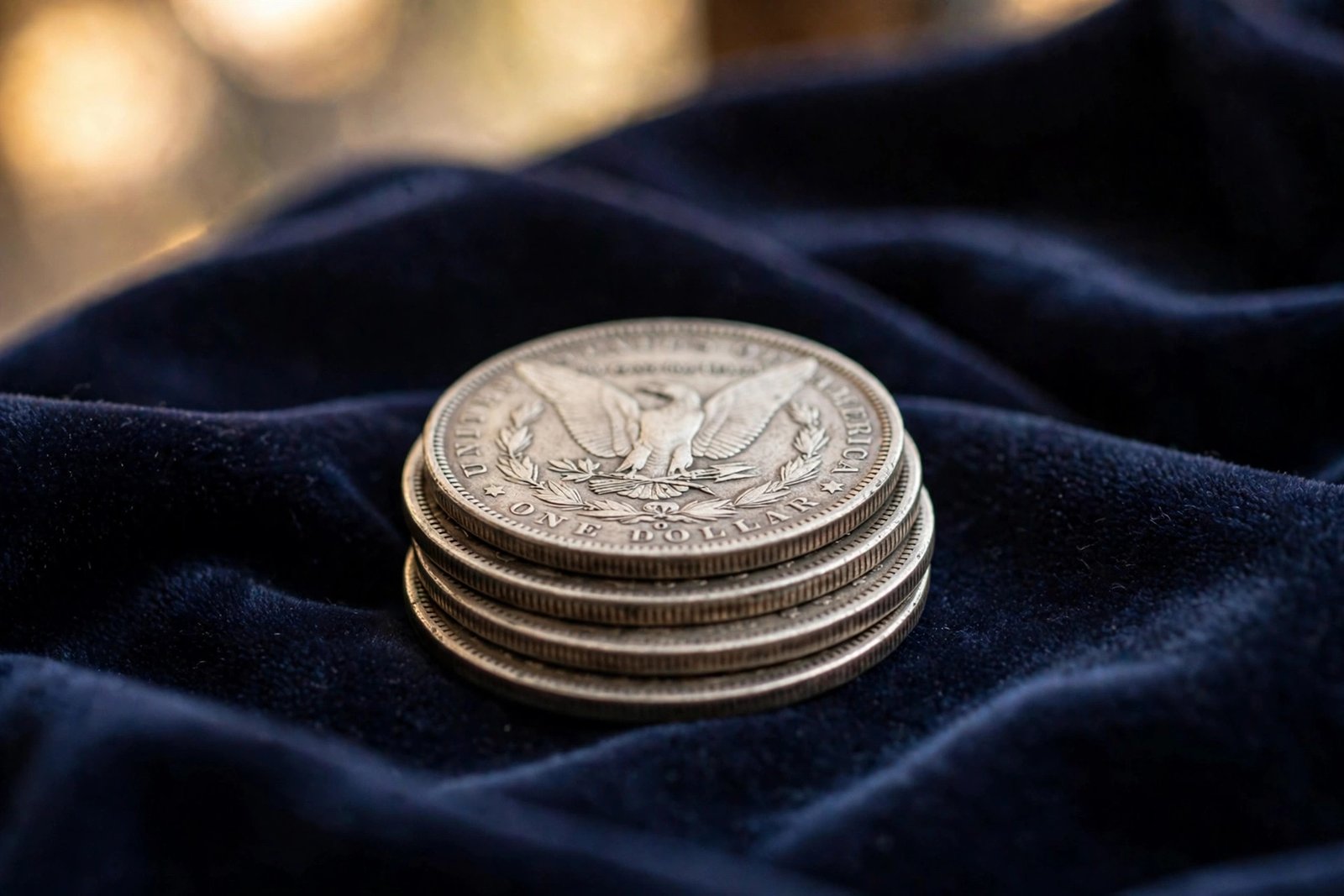
Mint mark: on the back, under the wreath, above the DO in DOLLAR
If your coin is dated 1921, it is the most common year of all. If it is dated 1893 and has an S under the wreath, stop sorting and read the key dates section carefully.
A short history of the Morgan dollar
The Morgan dollar was born because of politics as much as money. In 1878, Congress passed the Bland-Allison Act, which required the government to buy large amounts of silver and turn it into silver dollars. The Mint needed a new design, fast.
English engraver George T. Morgan created it. His Liberty wears a cap and a crown of cotton and wheat. The eagle on the back clutches arrows and an olive branch.
The series ran from 1878 to 1904. Then the authorised silver ran out, production stopped, and the dies were later destroyed. In 1921, one more Morgan production run happened before the Peace dollar took over. That is why you see long, steady date runs — and then a single, very common 1921 at the end.
Mint marks matter so much because mintages varied enormously. Philadelphia made huge numbers of most dates. Carson City made far fewer, for far fewer years, and collectors love the romance of that Wild West mint.
The key dates worth real money
1893-S — the king of the Morgans
Only 100,000 were minted, the lowest mintage of any regular-issue Morgan. Worn examples are scarce. Clean, original examples are rare. This is undisputedly the hardest date in the series to find in high grade, and prices reflect it at every level.
1889-CC — the toughest Carson City date
Carson City struck just 350,000 of these. It is the key CC date most set builders chase last. Even well-worn genuine examples command a strong premium over common Morgans.
1895 — the proof-only mystery
No business strikes of the 1895 Philadelphia Morgan are known to exist. The Mint recorded only proof coins — 880 proofs struck. Every genuine 1895 Morgan you will ever see is a proof. That makes it one of the most famous and expensive coins in the series, and one of the most commonly faked.
1894 — small mintage, big demand
Philadelphia minted only 110,000 circulation coins in 1894. Survival was low, demand is constant, and prices stay high in every grade.
1903-O — the rarity that stopped being rare
For years, the 1903-O was considered a great rarity in high grade. Then, in the 1960s, bags of uncirculated examples came out of Treasury vaults and reached the market. Values fell sharply. It is now an affordable mint-state coin with one of the best stories in the whole series.
Morgan dollar value table
These are approximate retail ranges for genuine, problem-free coins. Silver content puts a floor under every Morgan. Rarity and grade build everything on top of that floor.
| Grade | Approx. value |
|---|---|
| Common date, circulated | $30–$45 |
| Common date, About Uncirculated | $50–$75 |
| Common date, Brilliant Uncirculated | $65–$120+ |
| Better date (semi-key), circulated | $60–$250 |
| 1894, circulated | $800–$1,500 |
| 1889-CC, circulated | $900–$2,000 |
| 1893-S, circulated | $3,500–$7,000 |
| 1893-S, mint state | $150,000+ |
| 1895 proof | $40,000+ |
Treat this table as a map, not a price tag. Two coins in the same grade can sell far apart because of toning, lustre, strike, and eye appeal.
What to look for — your checklist
- Find the mint mark first. Turn the coin over. Look under the wreath, just above the letters DO in DOLLAR. No letter means Philadelphia. CC means Carson City. S means San Francisco. O means New Orleans. D appears only on 1921 coins, from Denver.
- Check the date against the mint mark. Value lives in the combination. An 1893 from Philadelphia is a better date. An 1893-S is the king.
- Weigh it. A genuine Morgan should weigh about 26.73 grams. A coin that is far light deserves suspicion.
- Look at the high points. On the front, check Liberty’s hair above the ear and the cotton leaves. On the back, check the eagle’s breast feathers. Wear shows there first.
- Keep original surfaces. Dull grey, even toning, and honest wear are good signs. Bright, mirror-shiny circulated coins have almost always been cleaned — and cleaning cuts value hard.
- Note the strike. Some New Orleans coins were struck weakly in the centre. Weak strike is not the same as wear, and experienced buyers know the difference.
Fakes and altered mint marks — read this before you buy
Key-date Morgans are heavily faked. The most common trick is an altered mint mark: a common coin changed to look rare. A mint mark can be added, or a genuine S can be tooled to resemble a rarer mark, or a common 1893 Philadelphia coin can gain a false S.
Cast copies also exist. Look for soft, mushy detail, tiny bubbles in the surface, a seam on the edge, and a weight that is off. A genuine struck coin has crisp lettering and clean, sharp edges on the design.
For the 1895, 1893-S, and 1889-CC, certification is not optional extras territory. It is the normal, sensible way these coins trade. Buy those dates certified by PCGS or NGC, or be prepared to submit a raw coin for authentication before paying key-date money.
What to do if you find one
- Hold it by the edges only. Never touch the faces with your fingers if you can avoid it.
- Do not clean it. Do not polish it. Do not dip it. Original is valuable; cleaned is discounted.
- Record the date and mint mark, then weigh the coin on a small gram scale.
- Photograph both sides in natural light, straight on, without flash glare.
- Compare your coin with the key dates list above. If it matches a key or semi-key date, keep it separate from common coins.
- Get a key date certified before you sell. Certification confirms authenticity and grade, and serious buyers pay more for that certainty.
For more silver sorting help, pair this guide with our companion piece Are Your Quarters Silver? Every Washington Quarter Date to Look For (1932–1964) — the same date-plus-mint-mark method works there too.
FAQ
Are all Morgan dollars worth a lot of money?
No. Most circulated Morgans are common coins whose value is driven mainly by their silver content, roughly $30–$45 in recent market terms. Real premiums belong to key dates, Carson City issues, and high-grade uncirculated coins with original surfaces.
How can I tell where my Morgan dollar was minted?
Look at the back of the coin, under the wreath and above the DO in DOLLAR. No letter means Philadelphia. CC is Carson City, S is San Francisco, O is New Orleans, and D — found only on 1921 coins — is Denver.
Is a 1921 Morgan dollar rare?
No. The 1921 is the most common Morgan dollar of all, with the highest mintages in the series. A circulated 1921 is a silver-value coin, typically in that same $30–$45 range. Mint-state examples and the 1921-D and 1921-S carry modest premiums.
Should I clean a Morgan dollar to make it look better?
Never. Cleaning removes original metal and leaves unnatural surfaces that collectors can spot instantly. A cleaned coin can lose a large share of its value, sometimes most of its premium. Leave toning and honest wear exactly as they are.
Values are estimates based on grade, authenticity and current market demand at the time of writing (October 2026). A cleaned, damaged or counterfeit coin is worth far less. Get valuable coins certified by PCGS or NGC.