Are Your Quarters Silver? Every Washington Quarter Date to Look For (1932–1964)
Are Your Quarters Silver? Every Washington Quarter Date to Look For (1932–1964)
Somewhere in a change jar, a glove box, or the bottom of a purse, there is very likely a quarter worth several dollars instead of twenty-five cents.
It looks almost identical to every other quarter. It spends exactly the same at a shop. The only giveaway is the date — and one quick look at the edge.
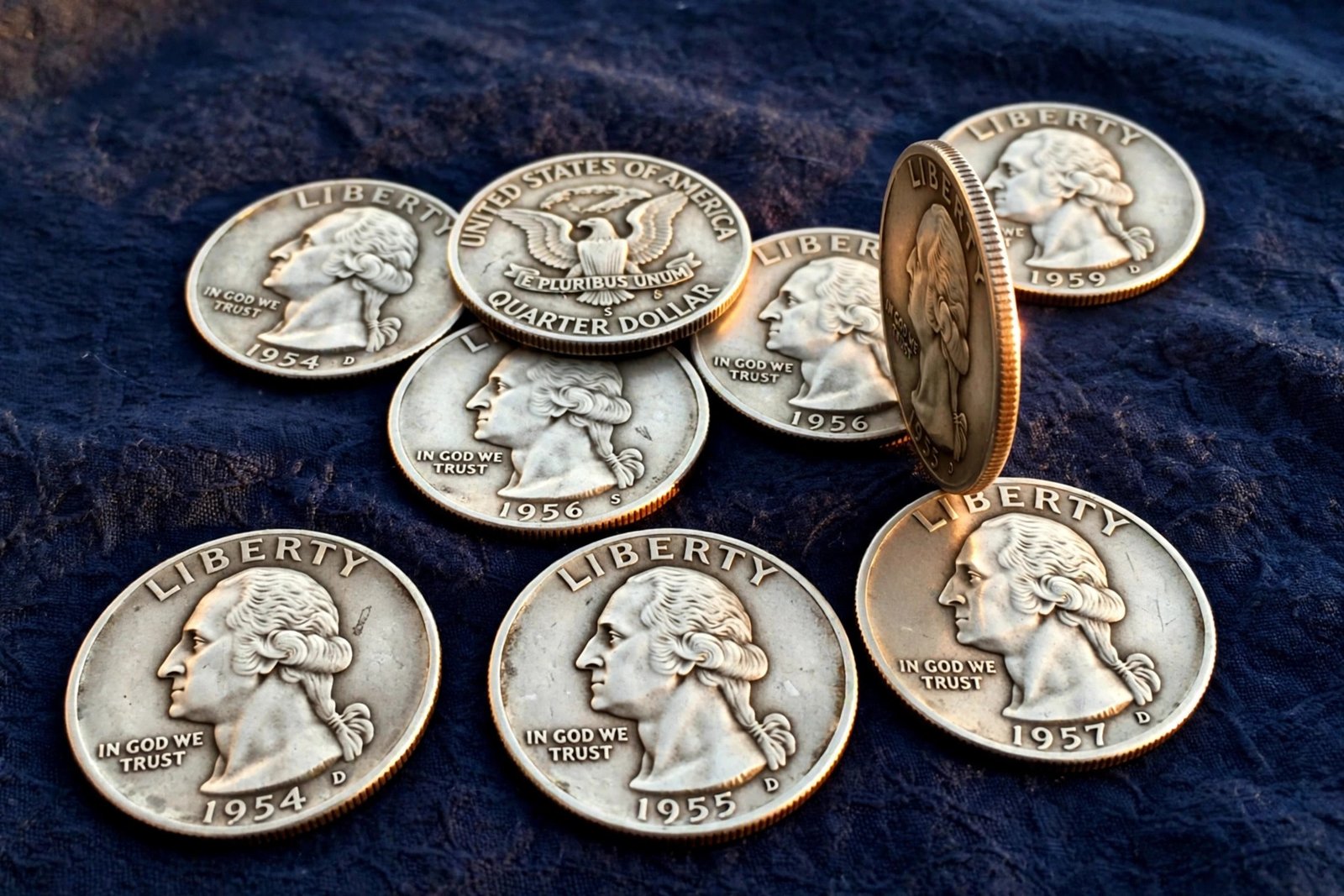
From 1932 to 1964, every Washington quarter made for circulation in the United States was struck in real silver. Millions were spent, worn smooth, and melted over the years, but plenty still survive in inherited collections, old rolls, and forgotten jars. Sorting them out takes about ten seconds per coin once you know the routine.
Quick answer
Silver years: every Washington quarter dated 1932–1964
Metal: 90% silver, 10% copper — 6.25 grams, containing 0.1808 troy ounces of pure silver
Fastest test: look at the edge. A silver quarter shows a solid silvery edge with no copper stripe.
Key dates: 1932-D and 1932-S, the two first-year rarities
Common value: mainly silver-driven — several dollars each, and the amount rises and falls with the spot price of silver
That last point matters. This guide will not pin a coin to one fixed melt figure, because silver moves every trading day. Your quarter holds 0.1808 ounces of pure silver. Multiply that by the current spot price and you have its metal floor.
Why 1964 is the magic date
The Washington quarter began in 1932, created for the 200th anniversary of George Washington’s birth. The design by John Flanagan, with Washington on the front and an eagle on the back, was meant to be a one-year commemorative. It proved so popular that it stayed.
For more than three decades, the recipe never changed: 90% silver. Then silver prices rose so high in the mid-1960s that the metal in a quarter became worth more than face value. From 1965 onward, quarters switched to the copper-nickel clad sandwich we still use today.
That is why the edge test works. A clad quarter shows a clear copper-coloured stripe around its rim. A silver quarter does not. People noticed the change and pulled the silver ones out fast — the ones still hiding today sit in collections and jars nobody has sorted yet.
The two key dates: 1932-D and 1932-S
The first year was struck during the Great Depression, and mintages outside Philadelphia were tiny. Those two small numbers drive the strongest prices in the whole silver Washington series.
1932-D — Denver, 436,800 minted
Only 436,800 quarters left the Denver Mint in 1932. That is a very low figure for a modern US coin, and heavy circulation claimed many of them. Genuine examples in decent grades are scarce, and this is the stand-out key date of the series.
1932-S — San Francisco, 408,000 minted
San Francisco made even fewer: 408,000 coins. The 1932-S is the lowest-mintage coin in the entire Washington quarter series. Together, the D and the S are the pair every set builder needs — and the pair most often faked, as the warnings below explain.
Beyond those two, most other silver Washington dates are common. A handful of 1930s and early 1940s mint-marked issues carry modest premiums in high grade, especially with sharp strikes, but for beginners the sorting rule stays simple: save every 1932–1964 quarter, then check the 1932 coins twice.
Washington quarter value table
Values below assume genuine, problem-free coins. Common dates trade mainly on silver content, so their prices breathe with the spot price — treat the range as a guide that moves.
| Grade | Approx. value |
|---|---|
| Common date, circulated | Several dollars each — silver-driven, varies with spot |
| Common date, lightly circulated | Silver value plus a small collector premium |
| Common date, mint state | $15–$40+ depending on date and strike |
| 1932-S, circulated | $175–$300 |
| 1932-D, circulated | $175–$325 |
| 1932-D or 1932-S, mint state | $1,000+ for attractive certified examples |
A worn 1957 quarter and a worn 1948 quarter are both, first and foremost, 0.1808 ounces of silver. Grade and date only take over once a coin is scarce or beautifully preserved.
What to look for — your checklist
- Start with the date. If it reads 1932 through 1964, set the coin aside as silver. No exceptions for regular circulation issues in those years.
- Confirm with the edge. Hold the coin sideways. No copper stripe means silver. A copper stripe means clad, dated 1965 or later, no matter how silvery the faces look.
- Find the mint mark. On silver Washington quarters, the mint mark sits on the back, below the wreath and above the words QUARTER DOLLAR. No letter means Philadelphia. D is Denver, S is San Francisco.
- Weigh a doubtful coin. A silver quarter weighs 6.25 grams. A clad quarter weighs 5.67 grams. The gap is easy to feel on a small digital scale.
- Listen, gently. Dropped a short distance onto a hard surface, silver has a clear, ringing tone. Clad sounds duller. Use this as a supporting clue only, and never drop a coin you think might be valuable.
- Sort the 1932 coins into their own pile. Then check mint marks on that pile with a magnifier before you do anything else.
Fakes and added mint marks — the one big warning
Because 1932-D and 1932-S quarters are valuable and the plain 1932 Philadelphia coin is common, altered coins are a real problem in this series. The classic trick is simple: take a common 1932 quarter and add a D or an S mint mark to the back.
Signs of an added mint mark include rough metal around the letter, a mark at a slightly wrong angle or position, glue traces, and lettering softer than the rest of the design.
Protect yourself with one rule: a raw, uncertified 1932-D or 1932-S should be treated as unproven until a grading service confirms it. Also beware of silver-plated clad quarters — the weight and edge checks catch nearly all of them in seconds.
What to do if you find one
- Pull out every quarter dated 1964 or earlier and keep them separate from your spendable change.
- Check the edges to confirm they are silver, then sort by date and mint mark.
- Set any 1932-D or 1932-S aside on its own, in a coin flip or soft cloth, held by the edges.
- Do not clean anything. Tarnish and toning do not hurt a common silver quarter, and cleaning can kill the premium on a key date.
- Check the live spot price of silver to value the common dates honestly, at 0.1808 ounces per coin.
- If you hold a genuine-looking 1932-D or 1932-S, get it certified before selling. Certified key dates reach far more buyers, at far better prices.
Ready to sort the bigger silver next? Our Morgan Silver Dollar Value Guide: Key Dates From 1893-S to 1921 uses the exact same date-and-mint-mark method on America’s most famous silver dollar.
FAQ
How can I tell if my quarter is silver without any tools?
Use the date and the edge together. A Washington quarter dated 1932–1964 is 90% silver, and its edge will be one solid silvery colour with no copper stripe. If you see copper on the rim, the coin is a later clad quarter, whatever the faces look like.
Are quarters from 1964 worth keeping if they are worn and common?
Yes. Even a worn, common-date silver quarter contains 0.1808 troy ounces of pure silver, so it is worth several dollars based on metal value alone — far more than face value. The exact amount moves with the spot price of silver on the day you check.
Did the United States make any silver quarters after 1964?
Not for circulation. Regular quarters from 1965 onward are copper-nickel clad with no silver. The Mint later sold special silver proof quarters to collectors in sets, but those were never issued as pocket change and are a separate collecting area.
Is my 1932-D quarter definitely valuable?
A genuine 1932-D is one of the two key dates of the series, minted at only 436,800 pieces, and circulated examples are worth roughly $175–$325. The caution is authenticity, since added mint marks are common on this date. Certification is the reliable way to confirm yours.
Values are estimates based on grade, authenticity and current market demand at the time of writing (October 2026). A cleaned, damaged or counterfeit coin is worth far less. Get valuable coins certified by PCGS or NGC.