A 1792 Half Disme Just Sold for a Record $2.93 Million — What It Means for Beginners
A coin smaller than a modern dime — worth five cents when it was made — has just become one of the most expensive American coins ever sold. On October 8, 2026, a 1792 half disme graded MS68 by PCGS sold for $2,928,000 at Heritage Auctions, after 66 bids. Heritage announced the result on October 12, 2026, calling it a record for the issue; the previous record for any half disme was $1.41 million, set at Heritage in 2013.
If you are new to collecting, that headline can mislead in two directions at once. No, your old coins are probably not worth millions. But this was not a random lottery win either. The price is the logical end point of four things collectors pay for — rarity, condition, history, and provenance — all arriving in a single coin at the same time.
Quick answer
What sold: a 1792 half disme, Judd-7 and Pollock-7, graded MS68 by PCGS, from the Ronald Firman Collection — the only half disme graded MS68 by PCGS. What it brought: $2,928,000 at Heritage Auctions’ October 8–9, 2026 GACC U.S. Coins Signature Auction (lot 3414), after 66 bids. The coins session realized $10,665,743, and with the companion currency auction the two events topped $19.39 million. Why it matters to beginners: the same auction also sold a worn half disme graded VG10 for $85,400. Same coin type, same history — a vastly different price, because condition was vastly different. And the silver in any half disme is worth only about $2–3. Nearly all of the $2.93 million is rarity, condition, and history, not metal.
A five-cent coin from the first days of American money
Start with the name. “Disme” is pronounced “deem” — an early spelling of “dime,” from the French word for a tenth. A half disme was therefore half a dime: five cents.
Congress passed the Mint Act on April 2, 1792, creating the U.S. Mint. But the Mint’s Philadelphia facility was not ready to strike coins, so the first half dismes were made in the cellar workshop of Philadelphia sawmaker and toolmaker John Harper. On July 13, 1792, Secretary of State Thomas Jefferson recorded receiving 1,500 of the new coins, worth $75 in total.
That 1,500 is the documented mintage; researchers believe several hundred more were struck later in 1792, putting the likely total between 1,500 and 2,000. Of those, fewer than 400 are thought to survive. President George Washington referred to the country’s “small beginning” in coinage in his address to Congress in November 1792 — and this coin is quite literally that beginning, even though collectors have traditionally grouped it with the experimental issues of 1792.
One legend deserves a caution flag. Older accounts sometimes call this the “Martha Washington half disme,” because the Liberty portrait was said to resemble the president’s wife, and some finest-known examples were long linked to David Rittenhouse, the first Mint director. Recent research has questioned the Rittenhouse link for this coin, and the portrait story is tradition, not documented fact. Treat both as interesting stories, not proven history.
What the coin looks like
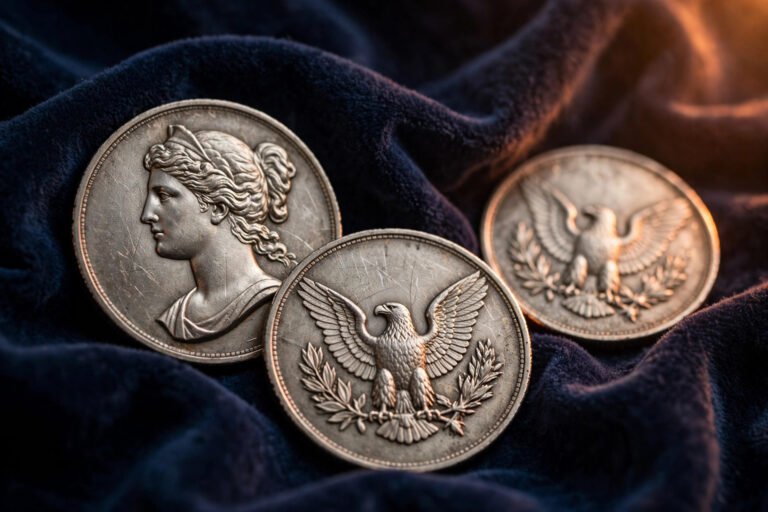
The half disme is tiny: 17.5 millimetres across, weighing 1.35 grams (20.8 grains), struck in about 89.24 percent silver with the rest copper — just 0.0387 troy ounces of pure silver. Its edge is diagonally reeded. The obverse shows Liberty facing left, with the date 1792 below the bust and the legend LIB. PAR. OF SCIENCE & INDUSTRY — short for “Liberty, Parent of Science and Industry.” The reverse shows a small flying eagle, with HALF DISME below it and UNI. STATES OF AMERICA around the border. Only one die pair was used for the silver issue, catalogued as LM-1, Judd-7, Pollock-7, rarity-4.
Note two things. The coin says “HALF DISME,” not “5 CENTS” — early American coinage did not always spell out values the way modern coins do. And it is a half dime, not a nickel: modern copper-nickel five-cent pieces did not arrive until 1866, and the later silver half dimes of 1794 onward are descendants of this coin, not the same thing.
Why this one brought millions
Condition. The record coin is graded MS68 — mint state, near-perfect, on the 1–70 Sheldon scale — and the only half disme PCGS has graded that high. Heritage praised its mint luster, preservation, and natural toning in shades of silver-gray, rose, amber, gold, and blue. At the top of any rare series, a single grade point can be worth hundreds of thousands of dollars, because there may be only one coin at that level. Our beginner’s grading guide explains the 1–70 scale in plain English.
Rarity. Fewer than 400 survivors from a mintage of at most about 2,000, and only one at MS68. Supply is fixed — no more 1792 half dismes will ever be made — while demand from collectors of early American coinage is deep.
History and provenance. This is the first circulating coin of the federal United States, tied to Jefferson, Washington, and the Mint Act itself, and it came from the Ronald Firman Collection. A documented chain of careful ownership reassures buyers that the coin is genuine, original, and well kept — and confidence is what lets two bidders push each other to $2.93 million over 66 bids.
Notice what is missing: silver, worth roughly $2–3 here. Metal is the floor for common coins. For rarities, it is a rounding error.
What half dismes are actually worth
Think of this table as a lesson in how grade moves price, using real results from the same October 2026 Heritage sale and the coin’s metal content.
| Finest certified survivor, Firman Collection | PCGS MS68 | $2,928,000 (October 2026, record) |
| Circulated survivor, same auction | PCGS VG10 | $85,400 (October 2026) |
| Any half disme, metal only | Melt value | About $2–3 in silver |
The gap between the first two rows is the entire hobby in miniature. A worn but genuine half disme is still a five-figure coin, because so few exist — but it is not a $2.93 million coin, because condition separates a historic artifact from a finest-known treasure. The key-date coins most beginners actually hunt work the same way on a smaller scale: the 1916-D Mercury dime, with only 264,000 minted, is worth a few dollars in silver as a common date but thousands as a rare date in high grade.
What to look for: a checklist for early coins
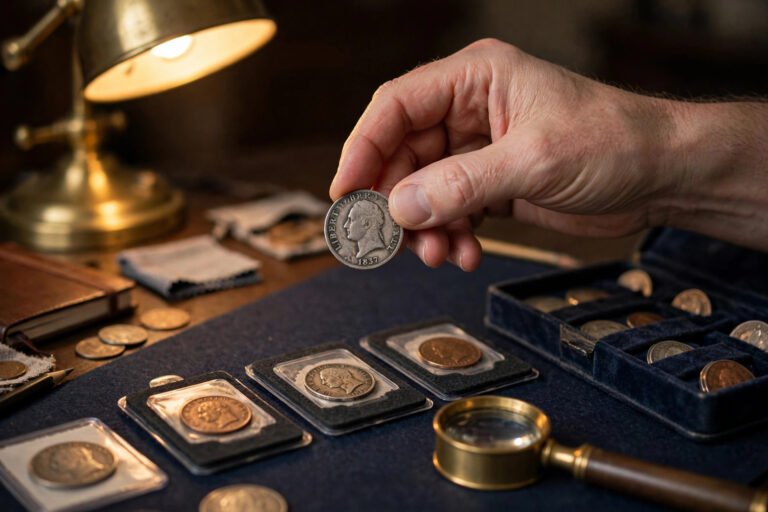
You will not find a half disme in your change jar, but the habits that would let you recognize one apply to every old coin you do find:
- Check the date first, then the denomination. A coin dated 1792 with “HALF DISME” on it is not a modern nickel, a dime, or an 1800s half dime. Read what the coin actually says.
- Look for the mint mark — and its absence. Early federal coins often have no mint mark at all, because Philadelphia was the only mint. An added or altered mint mark is one of the classic fakes on later key dates.
- Weigh it. A half disme weighs 1.35 grams and measures 17.5 millimetres. A cheap digital scale and calipers defeat many fakes, because counterfeiters often get the weight wrong.
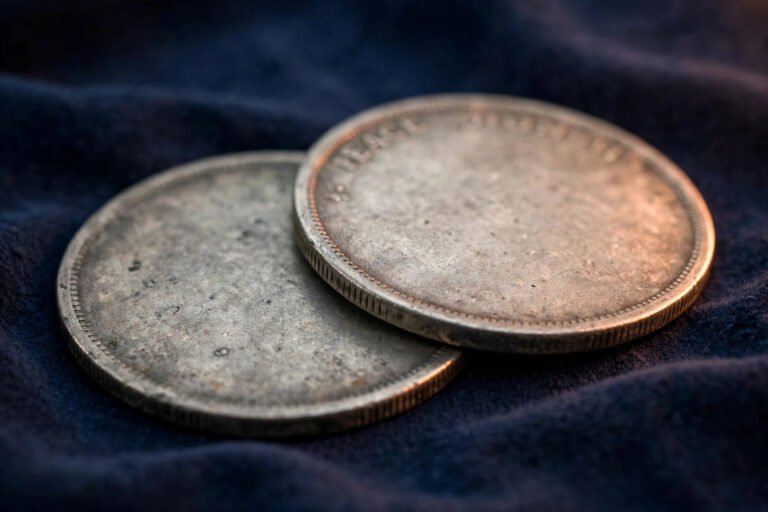
- Judge originality over shininess. The record coin’s value rests partly on its natural toning — the soft color silver picks up over centuries. A coin polished bright has usually lost value, not gained it.
- Separate the story from the coin. A great story adds interest, but only documented facts add value. Ask what can actually be proven before you pay a premium for a tale.
Fakes, cleaning, and other warnings
A $2.93 million headline is a magnet for fakes. Counterfeit early American coins exist in every grade, from crude cast copies to deceptive struck fakes, some made specifically to exploit famous sales like this one. If you are ever offered a 1792 half disme — or any coin whose price seems far too good for its story — assume it needs professional authentication first. Genuine rarities of this level are certified by PCGS or NGC, and their certification numbers can be checked.
Never clean an old coin, and never let anyone “improve” one for you. Cleaning strips away original surfaces and toning, and on a valuable coin it can destroy most of its worth in minutes. The record coin is valuable in part because nobody ever cleaned it. We explain exactly why cleaning is so destructive here. Be wary of look-alikes, too: later silver half dimes, replica tokens marked “copy,” and souvenir medals can all resemble early coinage at a glance.
What to do if you find an early coin
- Handle it by the edges, and put it in a holder or envelope right away. Do not clean, polish, or rub it.
- Photograph both sides, note the date, weight, and diameter, and write down where it came from.
- Check the basic facts against a reliable reference — PCGS CoinFacts, NGC, or the Red Book — before assuming anything about value.
- If it could be genuinely rare or valuable, get it certified by PCGS or NGC before you sell or insure it.
- Get more than one opinion on value, and be patient. Our guide to selling coins safely covers the dealer-versus-auction choice.
Most old coins you find will be worth a few dollars, not millions — and that is fine. Collecting is about the history in your hands, and the record half disme is a reminder of just how much history a five-cent coin can carry.
FAQ
Could I ever find a 1792 half disme in circulation?
Realistically, no. Fewer than 400 survive, and every known example is in a collection, a museum, or a dealer’s inventory. The valuable coins hiding in circulation are much later key dates, like the 1916-D Mercury dime.
Why is it called a “disme” and not a “dime”?
“Disme” is the early spelling of “dime,” from the French word for a tenth. A half disme is simply half a dime — five cents.
Is the $2.93 million price the silver value?
Not even close. The silver in a half disme weighs 0.0387 troy ounces, worth about $2–3. The $2,928,000 reflects rarity, condition, history, and provenance.
Does this sale make my old coins worth more?
Not directly. A record for one unique coin does not raise the value of common coins. It can draw attention to early American coinage generally, but your common-date coins are still valued on their own rarity, grade, and metal content.
Values are estimates based on grade, authenticity and current market demand at the time of writing. A cleaned, damaged or counterfeit coin is worth far less. Get valuable coins certified by PCGS or NGC.