Walking Liberty Half Dollar Value Guide (1916–1947): Key Dates, Mint Marks & Prices
It is the coin collectors call the most beautiful ever struck for circulation in America — and one your grandparents may have spent without a second thought. The Walking Liberty half dollar ran from 1916 to 1947, and it is the rare series where a beginner can start with a coin worth about twenty-five dollars and, with the same design, chase a key date worth tens of thousands. The difference between the two is usually a date, a small letter, and the grade.
Quick answer
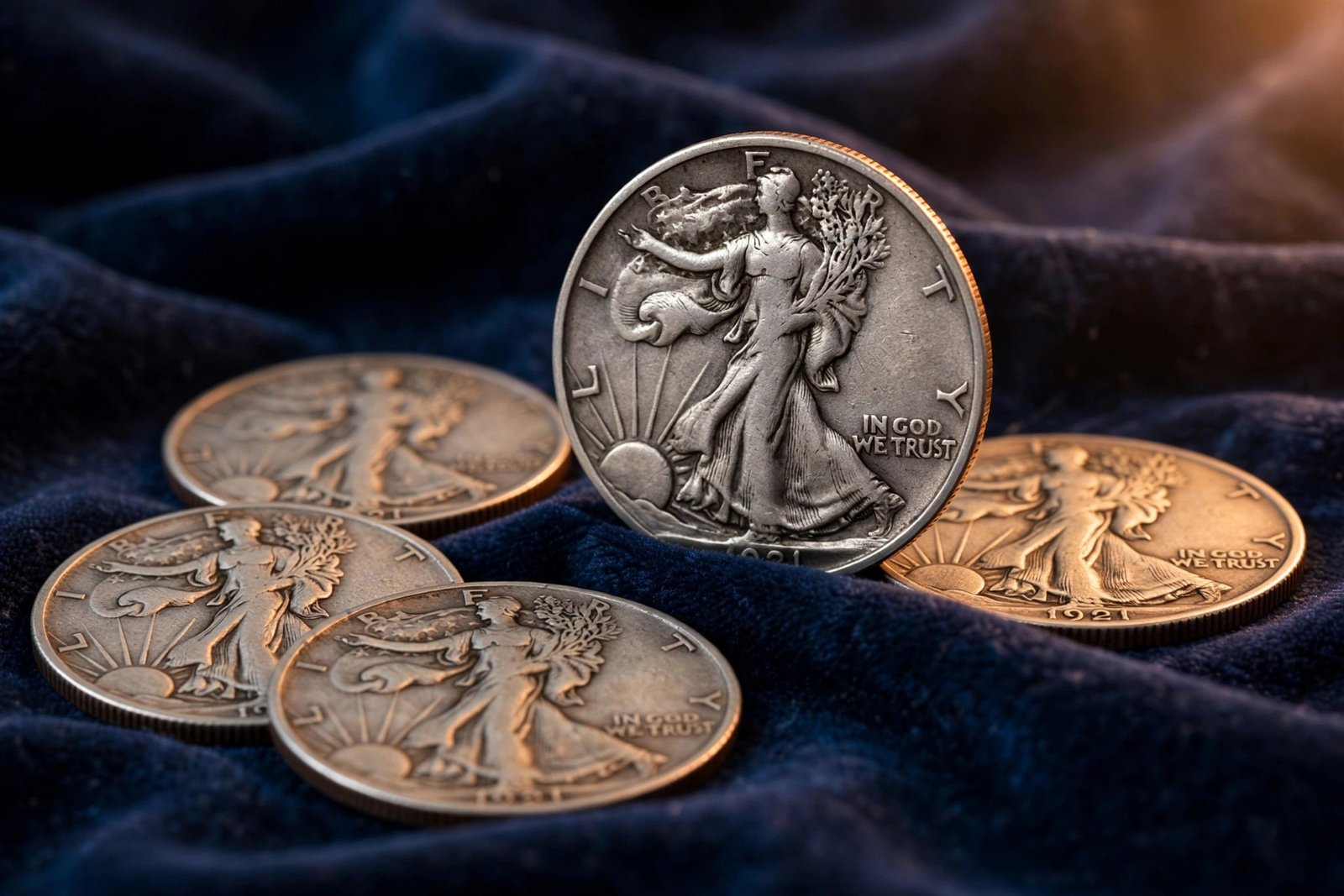
What it is: the Walking Liberty half dollar, struck 1916–1947, designed by sculptor Adolph A. Weinman. Liberty strides toward the rising sun on the obverse; an eagle stands on a mountain crag on the reverse. Every one is 90% silver and 10% copper, weighing 12.5 grams, with 0.3617 troy ounces of pure silver inside.
Most are modest: a common-date Walker in worn condition is typically worth roughly $25–$30 — a little above its silver melt value, about $19 at today’s silver price of roughly $52.50 an ounce (Kitco, November 9, 2026). In uncirculated condition, common late dates start around $50–$60 and reach roughly $150 in MS-65.
The dates to check first: the 1916-S (mintage 508,000) and the 1921 trio — 1921 (246,000), 1921-D (208,000, the lowest mintage in the series) and 1921-S (548,000). All four are worth hundreds even worn, and thousands in uncirculated condition. The 1938-D (491,600) is the late-series sleeper.
The trap: the mint mark moved. On 1916 and some 1917 coins it sits on the obverse, below “IN GOD WE TRUST”; from late 1917 onward it is on the reverse, at lower left. Check both sides before you price a 1916 or 1917 coin.
A short history: the prettiest coin in your pocket
In 1916 the Treasury held a competition to redesign America’s silver coins, inviting artists from outside the Mint for the first time in decades. Adolph A. Weinman won the half dollar with an image that has never really been topped: Liberty, draped in the American flag, striding toward the rising sun, carrying branches of laurel and oak. The design was so loved that the Mint brought it back in 1986 for the obverse of the American Silver Eagle, where it still appears today.
The series spans two world wars and the Great Depression, and the mintages tell that story. The first year was tiny — Philadelphia struck just 608,000 halves in 1916, Denver 1,014,400 and San Francisco 508,000. Then the post-war recession of 1921 cut mintages to a few hundred thousand, and no half dollars were struck at all in 1922, 1924–1926, or 1930–1932. Demand returned in the 1930s, and the war years produced the biggest mintages in the series — Philadelphia struck 53,190,000 halves in 1943, the highest figure of any Walking Liberty issue. The series ended in 1947, and the Franklin half dollar took over in 1948.
What to look for: the beginner’s checklist
- The date. It sits on the obverse, below Liberty’s feet. On heavily worn coins the last digit can be hard to read, so use a loupe and good light — a 1921 is worth a fortune and a 1941 is worth about twenty-five dollars.
- The mint mark — and which side it is on. For 1916 and early 1917 coins, look on the obverse, just below “IN GOD WE TRUST”. From late 1917 onward, look on the reverse, at lower left. No mark means Philadelphia; D means Denver; S means San Francisco. This is the most common beginner mistake in the series — a 1916-S is a key date, but only if you find the S on the obverse.
- The silver test. Every Walker is 90% silver, so it should weigh 12.5 grams and measure 30.6 mm across, with a reeded edge. A coin that is light, magnetic, or the wrong size is a counterfeit or a copy.
- Liberty’s head and hand. PCGS and NGC award a “Full Head” designation to Walkers where Liberty’s head, hair and hand details are sharply struck and complete. A Full Head coin in the same grade as a weakly struck one can be worth several times more.
- The strike. Some dates, most famously the 1921-S, are notoriously weakly struck — Liberty’s hand and the eagle’s feathers can look soft even on an uncirculated coin. Do not confuse a weak strike with wear; a weak strike is how the coin left the Mint.
- The key-date diagnostics. The 1921, 1921-D and 1921-S are the most faked Walkers, usually by adding a D or S mint mark to a common 1921 Philadelphia coin, or by altering a 1941 date. If you think you have one, buy it certified or get it authenticated before you pay key-date money.
The key dates: 1916-S and the 1921 trio
1916-S — the first-year king. San Francisco struck just 508,000 Walking Liberty halves in 1916, the lowest mintage of the first year and one of the lowest in the whole series. Only about 25,000 are believed to survive. Even heavily worn examples are worth well over $100, and a gem MS-65 example is worth roughly $4,500 or more. The 1916 Philadelphia (608,000) and 1916-D (1,014,400) are also keys, but the 1916-S is the prize.
1921, 1921-D and 1921-S — the recession trio. After the war, demand for coinage collapsed, and the Mint struck almost nothing: 246,000 at Philadelphia, 208,000 at Denver and 548,000 at San Francisco. The 1921-D is the lowest-mintage Walking Liberty of all, and the scarcest in circulated grades — only about 10,000 examples are believed to survive. The 1921-S is the condition rarity, hardest to find in gem condition, which is why the series auction record belongs to a 1921-S — an NGC MS-66 that sold for $188,000 at Heritage in June 2016. A 1921-D in PCGS MS-66 with CAC approval brought $183,000 at Stack’s Bowers in September 2026.
1917-S (obverse mint mark) — the quiet semi-key. The 1917-S with the mint mark on the obverse had a mintage of 952,000 and is considerably scarcer than its reverse-mint-mark twin. It is the date most beginners miss, because they check the reverse and find nothing.
1938-D — the late-series sleeper. Denver struck just 491,600 halves in 1938, the lowest mintage of the late period. Collectors saved rolls once the mintage was known, so it is not as rare as the number suggests — but it still carries a genuine premium in every grade, roughly $85 even in Good, and about $1,000 in MS-65.
The affordable way in. The “short set” — the twenty coins from 1941 through 1947 — is the classic beginner project. Every date is common, every coin is 90% silver, and a full circulated set can be built for a few hundred dollars. It teaches you grading, mint marks and strike quality before you spend key-date money.
Value table by grade
These are commonly cited guide ranges, framed as estimates — guides disagree by hundreds of dollars on the key dates, especially in low grades, and prices move with the silver market and demand. A coin’s value is its date, its mint mark and its grade, in that order, and the silver price sets the floor underneath all of them. If you have not already, read our guide on how to grade a coin before pricing anything.
| Coin | Worn (Good) | Very Fine | Uncirculated (MS-65) |
|---|---|---|---|
| Common late date, 1941–1947 | About $25–$30 | About $30–$40 | About $150+ |
| 1916 Philadelphia | About $60–$100 | About $150–$225 | About $1,150+ |
| 1916-D (obverse mint mark) | About $55–$100 | About $165–$225 | About $1,075+ |
| 1916-S (obverse mint mark) | About $135–$160 | About $580–$800 | About $4,500+ |
| 1921 Philadelphia | About $150–$225 | About $1,200–$2,000 | About $11,250+ |
| 1921-D | About $250–$375 | About $2,000–$3,250 | About $13,250+ |
| 1921-S | About $150–$200 | About $2,500–$3,750 | About $45,000+ |
| 1938-D | About $85 | About $140 | About $1,000 |
Note the gap between the first row and the rest: a common late-date Walker is worth roughly its silver plus a small premium, while a worn 1921-D is worth roughly ten times as much. Date and mint mark matter far more than condition for the keys, and condition matters far more than date for the common coins.
Fakes, altered coins and cleaning warnings
The Walking Liberty series is faked in three main ways, and the key dates attract all of them. First, added mint marks: a D or S is engraved or soldered onto a common 1921 Philadelphia coin to create a fake 1921-D or 1921-S, or onto a 1916 Philadelphia coin to create a fake 1916-S. Under magnification the added letter usually sits at the wrong height, has the wrong shape, or shows tool marks around it. Second, altered dates: a 1941 is re-cut into a 1921, which is why you should always check the shape of the 2 and the 1 against a genuine example. Third, outright counterfeits, mostly from overseas, in the wrong metal — a genuine Walker weighs 12.5 grams and is not magnetic, so a scale and a magnet catch most of them.
Never buy a raw key-date Walker from an unknown seller. The 1921 trio and the 1916-S should be bought certified by PCGS or NGC unless you can authenticate one yourself — the premium for a slabbed coin is far smaller than the cost of a fake. And never clean one: a polished, dipped or scrubbed Walker loses its original surfaces, and with them most of its collector value — the same rule as every silver coin, covered in our guide on why you should never clean a coin. Handle Walkers by their edges and keep them in capsules or a proper album.
What to do if you find one
- Do not clean it. No polish, no dip, no toothbrush — cleaning destroys value, and the damage cannot be undone.
- Check the date and the mint mark on the right side. Remember: obverse for 1916 and early 1917, reverse from late 1917 onward. Write down exactly what you have before you look up a price.
- Weigh it. 12.5 grams on a scale that reads to a tenth of a gram, and 30.6 mm across. If it is light or magnetic, treat it as suspect.
- Estimate the grade honestly. Compare it against graded examples online or in our grading guide — most coins found in the wild are Good to Very Fine.
- If it is a 1916-S, a 1921, a 1921-D, a 1921-S or a 1938-D, get it certified. Send it to PCGS or NGC, or take it to a reputable dealer for an in-hand opinion first.
- For a common date, decide whether to keep or sell. Common Walkers are easy to sell to any coin dealer or at a show, at roughly melt plus a small premium — and if you are thinking of selling, our guide on how to sell your coins safely covers dealers, auctions and when grading first is worth it.
Frequently asked questions
Are Walking Liberty half dollars still found in circulation?
Almost never. They were replaced by the Franklin half in 1948, and the silver was pulled from circulation in the 1960s when silver prices rose. A Walker turns up today in an inherited collection, a bank roll hunt, an estate sale or a dealer’s junk-silver box — not in your change from the shop.
How much silver is in a Walking Liberty half dollar?
Each one contains 0.3617 troy ounces of pure silver — 90% silver and 10% copper, weighing 12.5 grams in total. At about $52.50 an ounce (November 9, 2026), that is roughly $19 of silver. That is the floor: no genuine Walker is worth less than its melt value, and most are worth more.
Which Walking Liberty half dollar is the most valuable?
The 1921-S holds the series auction record: an NGC MS-66 sold for $188,000 at Heritage in June 2016. The 1921-D is the lowest mintage at 208,000 struck, and a PCGS MS-66 example brought $183,000 in September 2026. In circulated grades, the 1921-D is usually the most valuable of the three 1921 issues.
Is a Walking Liberty half dollar worth collecting as a beginner?
Yes — it is one of the best beginner series in American coinage. Start with the 1941–1947 short set, twenty coins, all affordable and all 90% silver. Learn to grade them, learn the mint marks, and only then move up to the early dates.
Values are estimates based on grade, authenticity and current market demand at the time of writing. A cleaned, damaged or counterfeit coin is worth far less. Get valuable coins certified by PCGS or NGC.