1916-D Mercury Dime: The Little Silver Dime Worth Big Money
1916-D Mercury Dime: The Little Silver Dime Worth Big Money
It weighs two and a half grams. It can slip through a hole in a pocket without a sound. And one version of it, from one mint, in one year, is worth more than a thousand worn examples of its ordinary brothers combined.
The 1916-D Mercury dime is the key date of one of America’s best-loved coin series — and it hides in the same albums, rolls, and inherited dime collections as coins worth little more than their silver.
Most Mercury dimes are common. This one is not. Learning to spot it, check it, and protect it is one of the highest-value skills a beginner can pick up.
Quick answer
Coin: Mercury dime, Denver mint, 1916 — the first year of the design
Mintage: only 264,000 coins, the lowest of the regular series
Metal: 90% silver — 2.5 grams
Mint mark: a small D on the back, lower left, beside the olive branch
Circulated value: roughly $800–$1,100 for a genuine, problem-free example
Mint state: many thousands of dollars, and far more again with Full Bands
That mintage figure explains everything. Denver struck only 264,000 dimes in 1916 because the mint was busy preparing for other work that year. Almost all of them went straight into circulation and stayed there, wearing down for decades.
Meet the Mercury dime — who was not Mercury at all
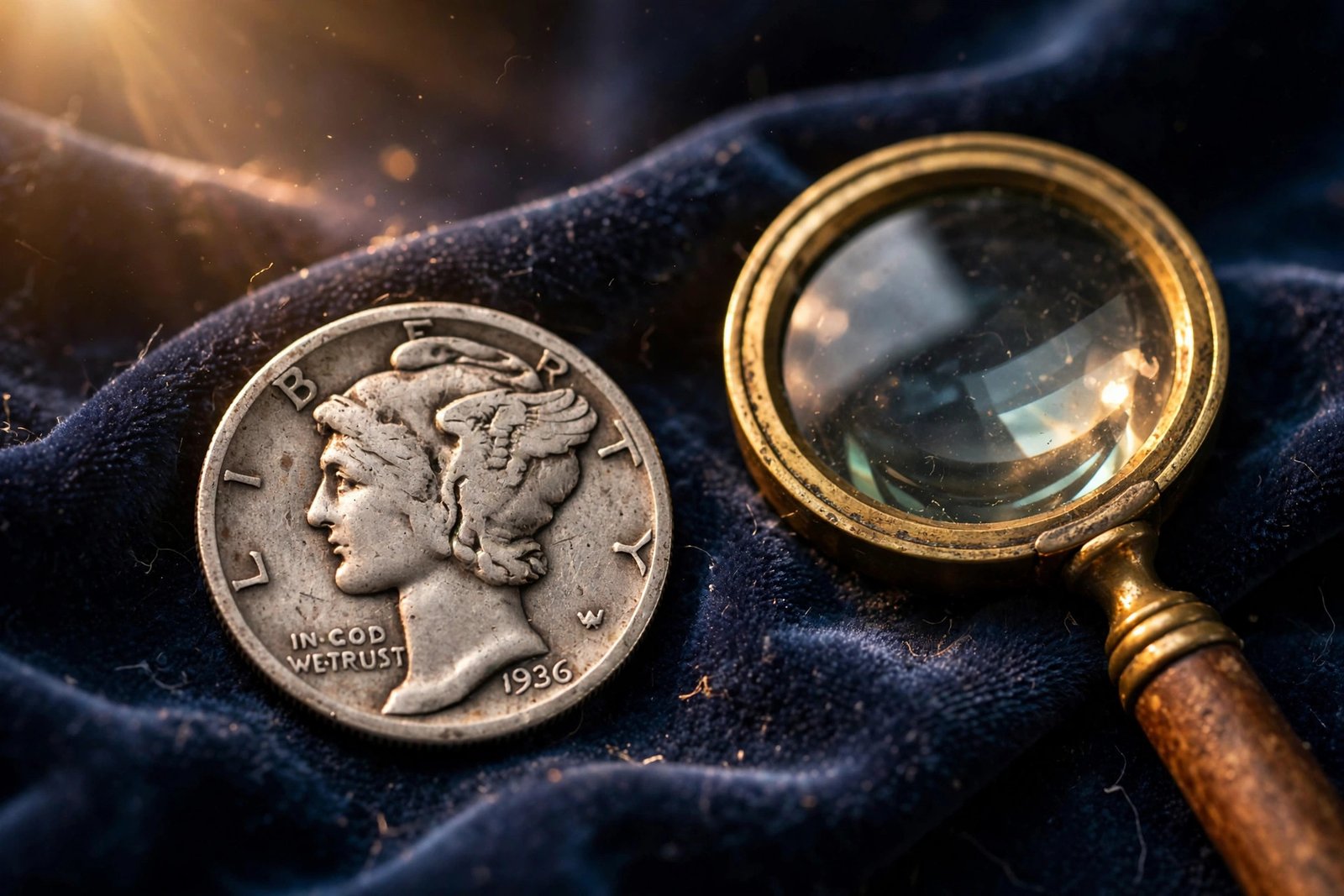
The series ran from 1916 to 1945, designed by sculptor Adolph A. Weinman. It is one of the most admired designs in American coinage: Liberty in a winged cap on the front, and a fasces — a bundle of rods with an axe, wrapped by an olive branch — on the back.
Here is the detail every collector learns sooner or later. The winged figure is Liberty, not the Roman god Mercury. The wings on her cap stood for liberty of thought. The nickname Mercury dime stuck anyway, helped by the resemblance to Mercury’s winged helmet, and collectors have used it ever since.
Weinman’s design replaced the Barber dime, and it was struck at three mints. For contrast, Philadelphia struck more than 22 million dimes in 1916, and San Francisco over 10 million. Denver’s 264,000 is a rounding error beside those numbers — and that is exactly the point.
Why Full Bands changes everything
Look at the back of a Mercury dime. The fasces is crossed by horizontal bands. On most coins, those bands were struck a little softly, or wore a little flat, so the lines between them blur together.
On a perfectly struck, perfectly preserved coin, the two central bands are split by a clean, complete line from side to side. Collectors call that detail Full Bands, and grading services mark it on the holder as FB.
Full Bands matters because it is rare, especially on early dates. A mint-state 1916-D is already a major coin. A mint-state 1916-D with Full Bands is a trophy that can sell for several times the price of an ordinary uncirculated example. When you read price guides for this date, always check whether the figure quoted is for a regular strike or an FB coin — the gap between them is enormous.
1916-D Mercury dime value table
These are approximate ranges for genuine, problem-free, certified-quality coins. Raw coins trade at a discount until authenticity and grade are confirmed.
| Grade | Approx. value |
|---|---|
| Good (heavily worn, dates and D readable) | $800–$950 |
| Fine to Very Fine (clear detail in hair and fasces) | $950–$1,400 |
| Extremely Fine | $1,600–$2,500 |
| About Uncirculated | $2,800–$4,000 |
| Mint State (MS-60 to MS-63) | $4,500–$9,000 |
| Mint State with Full Bands | $20,000+ for top examples |
Notice how even the humblest row sits near $800. That is what a mintage of 264,000 does to a popular first-year design. It is also, unfortunately, exactly why fakes exist — the subject of the warnings below.
What to look for — your checklist
- Confirm the date first. The coin must read 1916. Plenty of 1916 dimes are common Philadelphia or San Francisco coins.
- Find the mint mark on the back, lower left. Flip the coin over. The mint mark sits in the small space to the left of the bottom of the fasces, beside the olive branch and just inside the rim. A D there is the whole prize.
- Read the mark under magnification. A genuine D is crisp, upright, and proportioned like other Denver marks of the era. Study a certified photo before you judge your coin.
- Check the weight. A Mercury dime should weigh 2.5 grams. Significant deviation is a red flag.
- Study the surfaces. Genuine circulated examples show even, honest grey toning and consistent wear across both sides. A coin with a suspiciously perfect mint mark and a tired-looking coin around it deserves a second, sceptical look.
- Look at the bands anyway. Even if your coin is circulated, getting used to reading the fasces bands trains your eye for grade — and for spotting the rare uncirculated survivor.
Altered and added D mint marks — the essential warning
The arithmetic of fakery is brutal here. A common 1916 Philadelphia dime is an inexpensive coin. Add a small D to its back, and it impersonates a coin worth around a thousand dollars. Criminals have done exactly that for decades.
Common methods include gluing or soldering a tiny D cut from a cheap Denver dime of another date, or engraving a mark into a plain coin. Tell-tale signs include disturbed metal around the mark, a D that leans or sits in slightly the wrong spot, and soft detail in that one area.
No checklist replaces expertise on this date. A 1916-D should be certified: PCGS and NGC examine the mint mark area under magnification and confirm authenticity. Whole counterfeits also circulate online, so buy from reputable dealers and be suspicious of prices that look like gifts.
What to do if you find one
- Stop handling it. Pick it up by the edges and place it in a coin flip or a soft envelope on its own.
- Do not clean, polish, or rub it — even a light wipe can leave hairlines that cost hundreds of dollars on a key date.
- Photograph both sides clearly, including a close, straight-on shot of the mint mark area.
- Weigh it and compare the mint mark position with photos of certified examples.
- Resist quick cash offers until you know what you hold. An eager buyer is information in itself.
- Submit it for certification, or take it to a reputable dealer who can submit it for you. The certificate turns a claim into a fact, and a fact into full value.
If small silver surprised you, the dimes pair naturally with their quarter-sized cousins in our guide Are Your Quarters Silver? Every Washington Quarter Date to Look For (1932–1964).
FAQ
Why is the 1916-D dime worth so much more than other 1916 dimes?
Mintage. Denver struck only 264,000 dimes in 1916, against more than 22 million at Philadelphia and over 10 million at San Francisco. It is a first-year coin of a beloved design, most examples circulated heavily, and collectors building sets all compete for the survivors.
Where exactly is the mint mark on a Mercury dime?
On the back of the coin, in the lower left area, to the left of the bottom of the fasces and beside the olive branch, close to the rim. No letter means Philadelphia. The valuable version for 1916 carries a small D for Denver in that spot.
What does Full Bands mean on a Mercury dime?
Full Bands, marked FB by grading services, means the two central horizontal bands on the fasces on the back are fully split by a clean, complete line. It shows an exceptional strike and preservation, and on a 1916-D it can multiply the value of a mint-state coin several times over.
Can I trust an uncertified 1916-D I find for sale online?
Be cautious. Added and altered D mint marks are a known, long-running fake on this exact date, alongside outright counterfeits. A certified coin from PCGS or NGC removes the authenticity gamble. If a price looks far too good for this key date, treat that as a warning sign, not a bargain.
Values are estimates based on grade, authenticity and current market demand at the time of writing (October 2026). A cleaned, damaged or counterfeit coin is worth far less. Get valuable coins certified by PCGS or NGC.