1955 Doubled Die Penny: Real Doubling vs Worthless Machine Doubling
1955 Doubled Die Penny: Real Doubling vs Worthless Machine Doubling
Have you ever looked at a penny and thought the date looked… blurry? Twice-printed? Like the coin was slightly cross-eyed?
On almost every coin, that blur is worthless. On one famous 1955 penny, it is worth well over a thousand dollars — and you can see it clearly with the naked eye, no microscope needed.
This is the 1955 Doubled Die Lincoln cent, the most famous error coin in America. This guide shows you what the real one looks like, how machine doubling tries to fool you, and how to tell them apart in about thirty seconds.
Quick answer: A genuine 1955 Doubled Die shows bold, split, doubled letters and date on the front only — the date, LIBERTY, and IN GOD WE TRUST are all clearly doubled to the naked eye. It is worth roughly $1,200+ in circulated condition and much more in Mint State red. Machine doubling is flat, shelf-like, and squeezed against the letters — it is damage from the press, and it adds no premium at all.
How does a doubled die happen?
First, a doubled die is not a coin that was struck twice. That is the most common misunderstanding in this whole topic.
A coin die is the stamp that strikes blank coins. Dies are made by pressing a hub bearing the design into the die — more than once. If the hub and die are slightly out of alignment (rotated) between those pressings, the die itself ends up with two offset impressions of the design baked into it.
Every coin that die then strikes comes out doubled, in exactly the same way, for the life of the die. That is why doubled die coins are collectible varieties, not one-off accidents: an estimated 40,000 of the 1955 doubled dies were made and released into circulation before the error was noticed, though estimates vary. They are rare, but findable — many were first spotted in cigarette vending machine change in New England.
What the real 1955 Doubled Die looks like
On a genuine example, the doubling is dramatic — collectors call this the “king” of doubled dies for a reason:
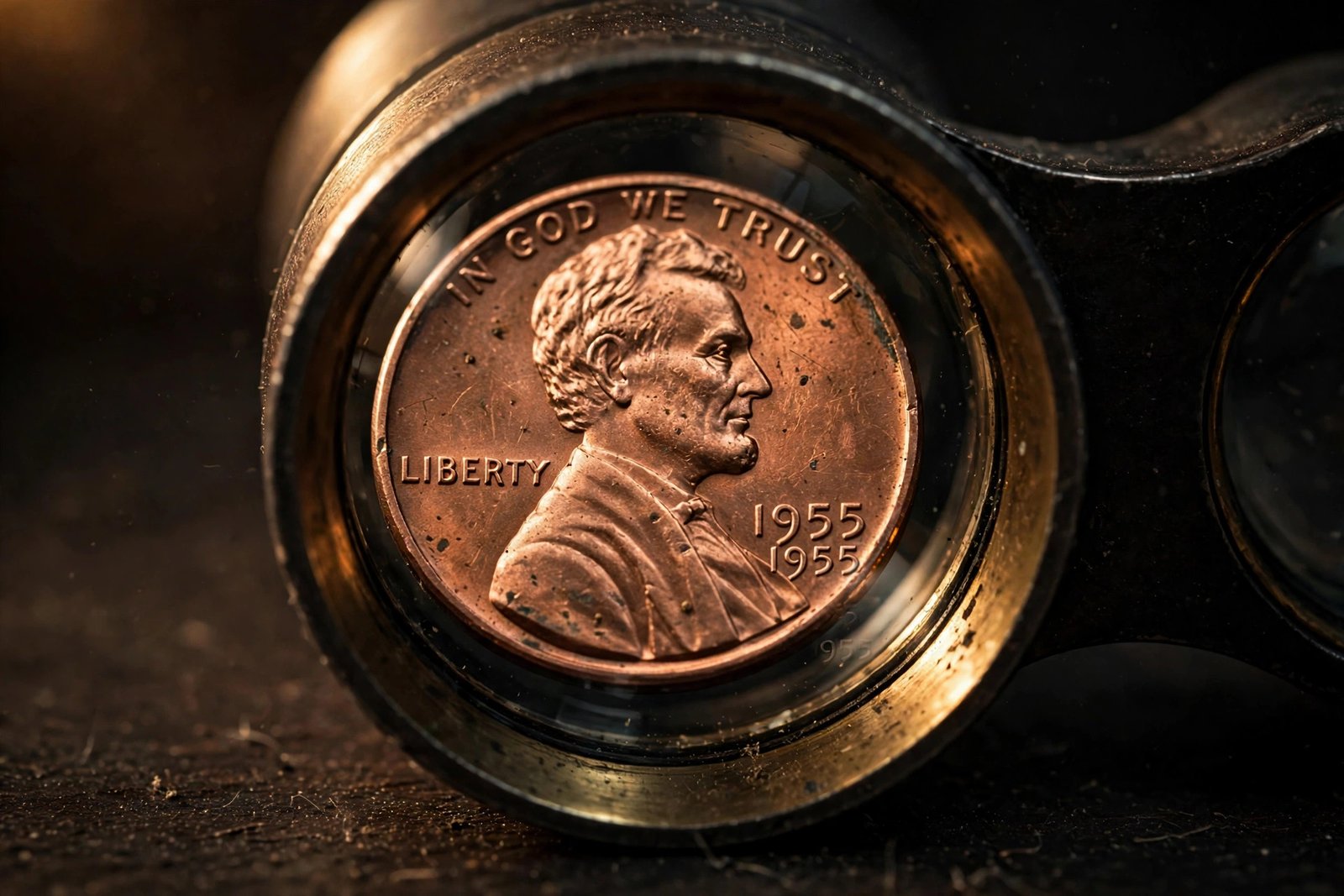
- The date is the first thing you see: 1955 appears twice, the two impressions clearly separated, like a shadow outline in solid metal.
- LIBERTY is strongly doubled in the same direction.
- IN GOD WE TRUST is also boldly doubled.
- The doubling is on the front (obverse) only. The wheat reverse is normal, because only one die was doubled.
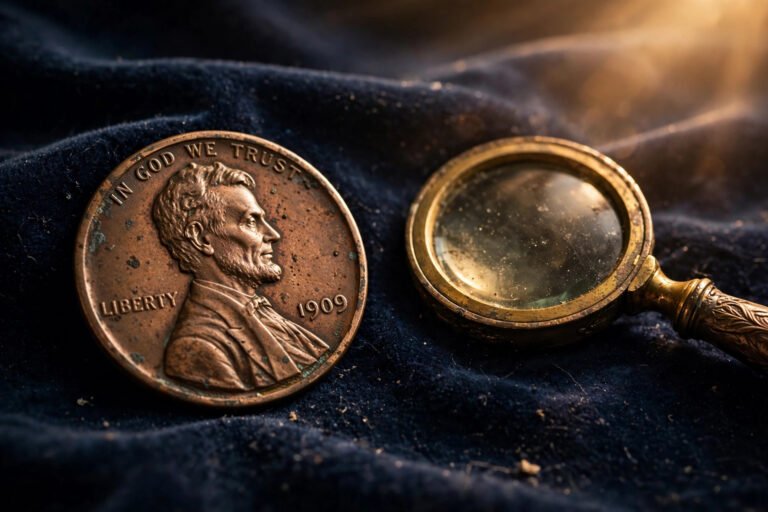
- The doubled letters are thick and rounded, with a visible split or notch where the two impressions separate. Look at the tops of the letters: genuine doubling shows two distinct, full outlines.
You do not need magnification to confirm a real one. If you have to squint, zoom, and convince yourself, it is not the famous 1955 doubled die.
The impostor: machine doubling
Machine doubling (also called strike doubling or mechanical doubling) happens at the moment of striking. The die shifts, vibrates, or the coin moves slightly, smearing part of the design. It can happen on any coin, in any year — and it is extremely common.
How it differs:
| Feature | Real doubled die (1955) | Machine doubling |
|---|---|---|
| Shape of doubling | Thick, rounded, two full outlines | Flat, thin, shelf-like step |
| Effect on letters | Letters are wider, split, notched | Letters look thinner — the “double” eats into them |
| Where it appears | Whole front design, consistently | Often one small area, inconsistent |
| Rarity | One die, ~40,000 released (estimates vary) | Very common, any date |
| Value | $1,200+ circulated | No premium — worth face value or normal coin value |
The shelf test is the one to remember: machine doubling looks like a flat step or terrace cut along one side of a letter. Real doubling looks like the whole letter was printed twice, in full, slightly offset.
Value table — genuine 1955 Doubled Die only
Values are for authenticated, problem-free examples. Colour matters: original red Mint State coins bring the strongest prices.
| Grade | Approx. value |
|---|---|
| Good to Fine (well circulated) | $1,200–$1,600 |
| Very Fine to Extremely Fine | $1,700–$2,500 |
| About Uncirculated | $2,500–$3,500 |
| Mint State, brown/red-brown | $3,500–$7,500 |
| Mint State, full red | Well over $10,000 for the finest examples |
A machine-doubled 1955 cent, by contrast, is worth what any common 1955 wheat cent is worth — a few cents circulated, a little more uncirculated. The gap between those two outcomes is exactly why learning the difference matters.
What to look for — checklist
- Stand back: is the doubling on the date obvious to the naked eye? The real one is
- Check all three areas together — date, LIBERTY, and IN GOD WE TRUST should all be doubled the same way
- Look for splits and notches at the tops and ends of letters (real) versus a flat shelf (machine)
- Check the letters are fat, not thin — machine doubling makes the main letter smaller
- Confirm the reverse is normal — the famous variety is doubled on the front only
- Ignore doubling on only one or two letters in a tiny spot — that is almost always machine doubling
Common mistakes and fakes
“I found one!” — on every other date. Modern Lincoln cents with dramatic-looking doubling turn up constantly in pocket change posts. In nearly all cases it is machine doubling, worth no premium. True, valuable doubled dies exist for other years too, but they are specific, catalogued varieties — a 1955 is only valuable with the bold, whole-front doubling described above.
The “Poor Man’s Doubled Die.” There is a common 1955 variety with weak, mushy doubling just on the last digit of the date, caused by a worn, deteriorated die. It has been nicknamed the “Poor Man’s Doubled Die” for decades and sells for a few dollars as a novelty. It is not the real coin.
Counterfeits. The real 1955 doubled die is valuable enough to fake, and copies exist, including altered and cast coins. Blurry or grainy detail, wrong weight (a genuine coin is bronze, 3.11 grams, and non-magnetic), and a too-good-to-be-true price are warning signs. As always, certification settles it.
Cleaning. Even a genuine doubled die loses serious value if it is cleaned or polished. The error lives in the surface detail — never scrub the evidence away.
What to do if you find one
- Photograph the front of the coin in clear light, straight on, before you do anything else.
- Run the checklist above: whole-front doubling, split thick letters, normal reverse, 3.11g weight.
- Do not clean it, and handle it only by the edges. Put it in a coin flip.
- Compare it with certified examples in the PCGS or NGC photo libraries — the doubling pattern must match exactly, because all genuine examples came from the same die.
- If it matches, submit it for certification. On this coin, authentication is what separates a $1,200+ collectible from an interesting story.
FAQ
How many 1955 doubled die pennies were made?
Estimates commonly put the number released at around 40,000, though published estimates vary. They were struck from a single doubled obverse die at Philadelphia (so there is no mint mark) before the error was caught, and many entered circulation in the Northeast.
Can a 1955 penny be doubled and still be worthless?
Yes — that is machine doubling, and it is very common. If the doubling is flat and shelf-like, appears in only a small area, or makes the letters look thinner, it adds no value, even on a 1955.
How much is a real 1955 doubled die worth?
Roughly $1,200 or more in circulated grades, rising through a few thousand dollars in About Uncirculated, and well over $10,000 for the finest full red Mint State examples. Cleaned or damaged coins are worth much less.
How do I know my coin is not a fake?
Match the doubling pattern exactly against certified examples, check the weight (3.11 grams, bronze, non-magnetic), and look for cast textures or mushy detail. Then let PCGS or NGC make the final call — buyers of this coin expect certification.
Error coins like this one are some of the most exciting finds in the hobby — and several sit alongside the key dates in our guide to the most valuable pennies.
Values are estimates based on grade, authenticity and current market demand at the time of writing (October 2026). A cleaned, damaged or counterfeit coin is worth far less. Get valuable coins certified by PCGS or NGC.