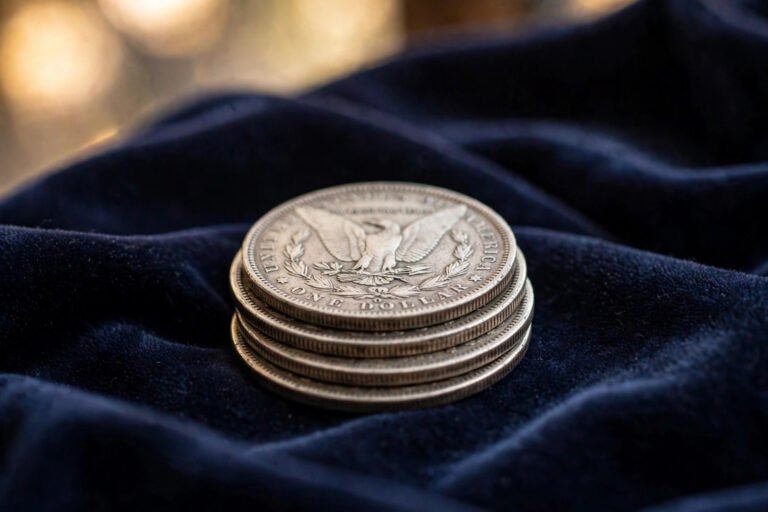
Bicentennial Quarters (1976): Are They Worth More Than 25 Cents?
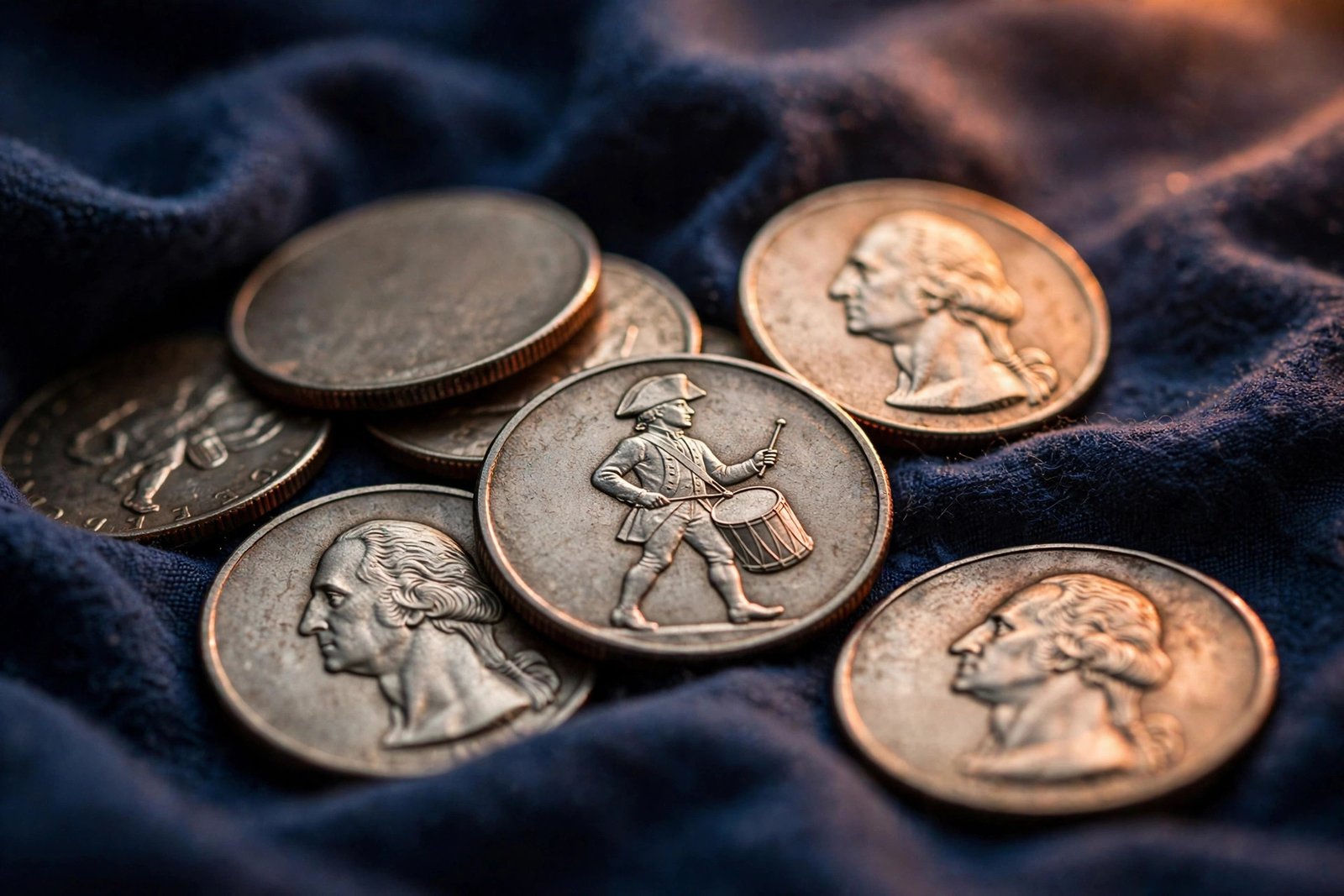
You have almost certainly held one. It is the quarter with the colonial drummer boy on the back and two dates on the front — 1776–1976 — instead of one. For fifty years it has turned up in pocket change, junk drawers and old coffee cans, and for fifty years people have asked the same question: is this one worth more than twenty-five cents?
The honest answer is: almost always, no. But the exceptions are real, and they are easy to miss if you do not know what separates an ordinary Bicentennial quarter from a silver one, or a common strike from a genuine error.
Most Bicentennial quarters are worth 25 cents. The Philadelphia and Denver circulation strikes were made by the hundreds of millions in copper-nickel clad, and worn examples still trade at face value.
The valuable ones are the exceptions: the 40% silver collector issues struck at San Francisco (S mint mark only), which carry a few dollars of silver plus a collector premium, and certified errors and top-grade examples, which can run into the hundreds or thousands.
The three checks that matter: the mint mark (S or not), the edge (a copper stripe means clad; a solid silver-coloured edge points to silver), and the weight (5.75 grams for silver versus 5.67 grams for clad). No single check proves silver on its own — use all three.
Ignore the viral headlines. There is no verified Bicentennial quarter sale anywhere near a million dollars. The credible auction record is a 1976-S silver quarter graded MS69 that sold for $19,200 at Heritage in June 2019 — and that coin was one of only three graded that high.
A short history: a birthday coin for the whole country
The Bicentennial quarter was struck to mark the 200th anniversary of American independence. Congress authorised special reverse designs for the quarter, half dollar and dollar, chosen through a national design competition. The winning quarter design, by Jack L. Ahr, shows a colonial drummer boy facing left, with a victory torch behind him encircled by 13 stars for the original colonies.
The obverse kept John Flanagan’s familiar Washington portrait, but with one change: instead of a single year, it carries the dual date “1776–1976”. That dual date is the source of a common confusion. Bicentennial quarters were struck in both 1975 and 1976, but every one of them bears the dual date. No quarter dated only “1975” was ever struck, and there is no regular 1976 quarter with the old eagle reverse — the eagle returned in 1977.
The coins were made in two very different versions. The circulation version, struck at Philadelphia and Denver, is copper-nickel clad: outer layers of 75% copper and 25% nickel over a pure copper core, weighing 5.67 grams. The collector version, struck only at San Francisco, was 40% silver — outer layers of 80% silver and 20% copper over a mostly copper core — weighing 5.75 grams. The silver issues were sold directly to collectors in sets; they were never released into general circulation. Any silver Bicentennial quarter found in change escaped from a set somewhere along the way.
The mintages explain the whole value story. Philadelphia struck 809,784,016 clad quarters and Denver struck 860,118,839 — together, more than 1.67 billion coins. San Francisco struck about 7,059,099 clad proofs, plus roughly 11 million silver uncirculated pieces and about 4 million silver proofs (the silver sets were sold over a decade, and unsold pieces were melted). More than 1.69 billion Bicentennial quarters in total. When a coin was made in those numbers, “old” and “commemorative-looking” do not make it rare.
What to look for: the beginner’s checklist
Work through these in order whenever you pick up a Bicentennial quarter:
- Read the date. It should say 1776–1976. If it does, you have a Bicentennial quarter; the dual date covers coins struck in both 1975 and 1976, so you cannot date it more precisely than that.
- Find the mint mark. It sits on the obverse, to the right of Washington’s neck. No mark means Philadelphia, D means Denver, S means San Francisco. Only S-mint coins can be silver — but an S alone does not prove silver, because San Francisco also struck clad proofs.
- Check the edge. Hold the coin edge-on. A clad quarter shows a copper-coloured stripe sandwiched between silver-coloured layers. A silver quarter’s edge looks uniformly silver-coloured, with no copper stripe. This is the quickest test, and it works on circulated coins too.
- Weigh it, if you can. Silver quarters weigh 5.75 grams; clad quarters weigh 5.67 grams. The difference is only 0.08 grams, so you need a scale that reads to 0.01 grams — a kitchen scale will not do it.
- Look at the drum. The drummer design was struck in high relief, and the drum’s top rim and clasp often came out weakly struck, especially on Philadelphia and Denver coins. A weak drum is a common strike-quality quirk, not an error. A fully struck, crisp drum is a genuine premium feature on an uncirculated coin.
- Check the condition honestly. A worn, scratched or cleaned coin is worth less than a sharp, original one at every level. If you are unsure how to judge wear, our beginner’s grading guide walks through it with photos to compare.
Clad or silver? The test, done properly
A shiny, mirror-like S-mint quarter is not automatically silver: San Francisco’s clad proofs are also mirror-finished and also carry the S mint mark. Shine proves nothing. What proves silver is the combination: S mint mark, plus a solid silver edge with no copper stripe, plus a weight of 5.75 grams. If all three agree, you almost certainly have a 40% silver piece. If the edge shows copper, it is clad, whatever the mint mark and however shiny it looks.
The silver in one of these coins is modest but real. Forty percent of 5.75 grams is about 2.30 grams of pure silver — roughly 0.074 troy ounces. At a spot price of roughly $49 per troy ounce on 3 November 2026, that works out to about $3.60 of metal. That is a floor, not a price: collectors pay more than melt for these coins, dealers buy below melt, and the spot price moves daily.
For context on the wider quarter family, see our guide to which Washington quarters are actually silver — the pre-1965 quarters are 90% silver, a very different proposition from the 40% Bicentennial issues.
Value table by grade
These are commonly cited guide ranges, framed as estimates — guides disagree, especially at the top end, and prices move with demand. A cleaned, damaged or counterfeit coin is worth far less at every level.
| Coin | Typical guide range (estimate) |
|---|---|
| Circulated clad, Philadelphia or Denver | 25 cents (face value) |
| Uncirculated clad, Philadelphia or Denver | About $1–$5 |
| Clad proof, San Francisco (S) | About $1–$5 |
| 40% silver uncirculated, San Francisco (S) | About $5–$20 in ordinary grades |
| 40% silver proof, San Francisco (S) | About $7–$40 in ordinary grades |
| Certified top grades and genuine errors | Hundreds to thousands; see below |
Two patterns stand out. First, the jump from ordinary to superb is enormous: an ordinary silver uncirculated quarter is a $5–$20 coin, but the 1976-S silver quarter graded MS69 — one of only three at that grade — sold for $19,200 at Heritage in June 2019. Second, circulated clad coins never escape face value, however long you keep them. Age alone does not create value; scarcity and condition do.
The errors worth knowing (and the ones that are not errors)
1976-D doubled die obverse. The genuine doubled die shows clear doubling on LIBERTY and the date; a certified top-grade example sold for about $8,400 in 2023, and lower grades are worth far less. Most “doubling” beginners spot is machine doubling — flat, shelf-like and worth no premium — not a true doubled die. If you think you have one, get it attributed by PCGS or NGC before celebrating.
Off-centre strikes, clipped planchets and broadstrikes. These genuine mint errors do occur on Bicentennial quarters, and values vary widely with severity — a dramatic off-centre strike is worth far more than a barely noticeable clip. Only certified or clearly dramatic examples command real money.
Wrong-planchet strikes. Quarters struck on dime blanks are rare and genuinely valuable — certified examples have sold for thousands — but they are also among the most faked “errors” offered online. A real one is noticeably smaller and lighter than a normal quarter. Never pay error prices for an uncertified example.
Weak drum detail. This is not an error at all. It is the commonest strike weakness in the series, and a seller describing a weakly struck drum as a “rare error” is either mistaken or hoping you are.
Fakes and cleaning warnings
Bicentennial quarters are not among the most counterfeited coins, but two traps are common. The first is the doctored “error”: ordinary coins altered to look off-centre or doubled, sold raw online at error prices. The second is the inflated silver claim: a clad S-mint proof sold as silver to a buyer who checked the mint mark but not the edge. The edge test and a 0.01-gram scale defeat both, and certification settles anything expensive.
And the rule that applies to every coin applies here with full force: never clean a coin to make it look better. Polishing, dipping or scrubbing strips original surfaces and can cut a coin’s value in half or worse. A dark, original Bicentennial quarter is worth more than a bright, scrubbed one, every time.
What to do if you find one
- Check the mint mark, the edge and — if you can — the weight, before assuming anything.
- If it is clad and circulated, it is worth 25 cents. Spend it, or keep it: Bicentennial quarters are one of the cheapest ways to start a collection, precisely because they cost face value.
- If it is silver, put it in a flip or holder and do not clean it. An ordinary silver example is a $5–$20 coin; a superb one deserves a second opinion.
- If you think you have a doubled die or another genuine error, do not sell it raw. Certification by PCGS or NGC is where the premium is protected — and where fakes are exposed.
- If it is uncirculated with a fully struck drum and sharp details, keep it safe and consider grading: the gap between an ordinary uncirculated coin and a certified MS67 or better is where the real money in this series lives.
The Bicentennial quarter is a perfect beginner’s coin for exactly the reason it disappoints treasure hunters: it teaches the difference between “old and interesting” and “rare”. More than 1.69 billion were struck, so the coin in your change jar is almost certainly worth a quarter. But check the edge, check the mint mark, and check the drum — because the silver one, the superb one and the genuine error are all still out there, hiding in plain sight.
FAQ
Are Bicentennial quarters silver?
Most are not. The Philadelphia and Denver circulation strikes are copper-nickel clad and contain no silver. Only the San Francisco collector issues are 40% silver — and San Francisco also struck clad proofs, so an S mint mark alone does not prove silver. Check the edge for a copper stripe and weigh the coin (5.75 grams for silver, 5.67 grams for clad).
Why does my quarter say 1776–1976 instead of one year?
The dual date marks the 200th anniversary of American independence. Bicentennial quarters were struck in both 1975 and 1976, but all of them carry the dual date, so there is no 1975-dated quarter and no way to tell from the date alone which year a given coin was struck.
Are Bicentennial quarters worth more than 25 cents?
Almost never, if they are circulated clad coins from Philadelphia or Denver — those are worth face value. Uncirculated clad examples are worth roughly $1–$5, silver S-mint examples roughly $5–$40 in ordinary grades, and only certified top-grade coins and genuine errors reach hundreds or thousands of dollars.
What is the most valuable Bicentennial quarter?
The credible auction record is a 1976-S silver quarter graded MS69 that sold for $19,200 at Heritage in June 2019 — one of only three graded that high. Ignore viral claims of million-dollar Bicentennial quarters; no verified sale comes close.
Values are estimates based on grade, authenticity and current market demand at the time of writing. A cleaned, damaged or counterfeit coin is worth far less. Get valuable coins certified by PCGS or NGC.