War Nickels (1942–1945): The Silver Nickels Hiding in Your Change
A nickel is the coin most people ignore. It is worth five cents, it is made of copper and nickel, and it is not worth a second look. Except that for a few wartime years, that was not true at all. Between late 1942 and 1945, the United States struck its five-cent coins out of an alloy that contained real silver — 35% of it — and those coins are still legal tender today. Every so often one still turns up in a roll of nickels or in pocket change, nearly eighty years after it was made.
The trick is knowing how to spot one, because a War Nickel looks almost exactly like an ordinary Jefferson nickel. The difference is a single oversized letter on the back of the coin — and once you know where to look, you will never miss it again.
Quick answer
The test: flip the nickel over. If there is a large P, D or S mint mark above the dome of Monticello on the reverse, it is a silver War Nickel, struck from 1942 to 1945 in an alloy of 56% copper, 35% silver and 9% manganese.
The silver inside: each War Nickel contains 0.05626 troy ounces of pure silver. Multiply that by the current silver price to get its melt value — at silver near $51 an ounce on October 30, 2026, that works out to roughly $2.85–$2.90.
The trap: not every 1942 nickel is silver. Early-1942 nickels were struck in the regular copper-nickel alloy, with a small mint mark beside Monticello or no mint mark at all. The big mark above the dome is the test — not the date alone.
The honest value: ordinary circulated War Nickels are common and trade close to their melt value. Real premiums belong to uncirculated coins, Full Steps examples and a couple of overdate varieties.
Why the nickel changed in wartime
Nickel — the metal, not the coin — was a strategic wartime material. It hardened the steel used for armour plate, tanks, ships and aircraft, and the war effort needed every pound of it. In March 1942 Congress authorised the Mint to change the five-cent coin’s composition, and after experimenting, the Mint settled on 56% copper, 35% silver and 9% manganese. The manganese was there for a practical reason: it made the new alloy work in vending machines, which rejected coins that did not behave magnetically like the old ones.
The change took effect in October 1942, and the wartime alloy stayed in production through the end of 1945. Regular 75% copper / 25% nickel composition returned in 1946. The wartime coins contain no nickel at all, which makes “War Nickel” a slightly ironic name: the only nickel without nickel in it.
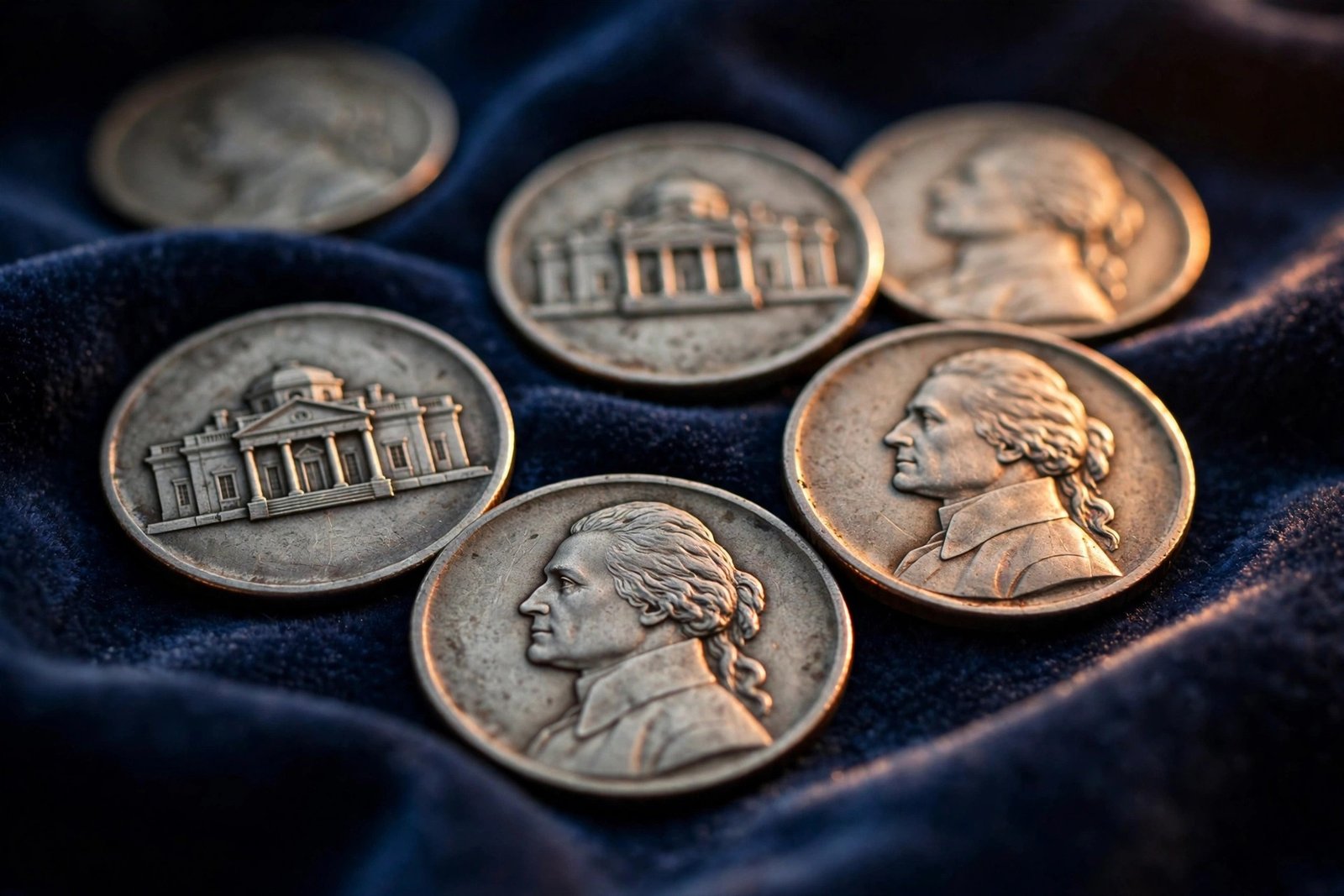
Nothing else about the design changed. The obverse still shows Thomas Jefferson’s portrait and the reverse still shows Monticello, his Virginia home, both designed by Felix Schlag. The coin kept the same weight, 5.00 grams, the same diameter, 21.2 millimetres, and a plain edge. Only the mint mark moved — and that move is the whole story for collectors.
The big mint mark: the one thing to look for
On a regular Jefferson nickel, the mint mark — if there is one at all — is small and sits to the right of Monticello, and Philadelphia coins carry no mint mark. On a War Nickel, the mint mark is large, bold, and placed directly above the dome of Monticello: a big P for Philadelphia, D for Denver, or S for San Francisco.
This was the first time a Philadelphia coin ever carried a P mint mark, and it was deliberate. The Mint wanted the silver coins to be easy to identify and sort out of circulation later, so the silver could be recovered if needed. That sorting never happened — the coins were never withdrawn — which is why they still turn up today.
So the identification checklist is short:
- Date between 1942 and 1945.
- Large mint mark above Monticello. P, D or S, big and obvious. If the mark is small and beside the building, or there is no mark at all, the coin is a regular copper-nickel issue — even if it is dated 1942.
- Weight near 5.00 grams if you want a second check. Weight alone cannot prove silver, since a War Nickel weighs the same as a regular nickel — but a coin far off 5.00 grams deserves suspicion (more on that below).
All 1943, 1944 and 1945 nickels are wartime silver issues. Only 1942 is split: early-1942 nickels are regular alloy, and only the later 1942 issues with the large mark above Monticello are silver. A 1942 nickel with a small mark or no mark is not a War Nickel, however tempting it is to assume otherwise.
How many were made
War Nickels were struck in enormous numbers — about 870 million in total across the three mints, according to Stack’s Bowers. That is the single most important fact for value: ordinary War Nickels are not rare, and no one should pay a rarity premium for a worn, common example.
| Year | Philadelphia (P) | Denver (D) | San Francisco (S) | Year total |
|---|---|---|---|---|
| 1942 (wartime alloy only) | 57,873,000 | — | 32,900,000 | 90,773,000 |
| 1943 | 271,165,000 | 15,294,000 | 104,060,000 | 390,519,000 |
| 1944 | 119,150,000 | 32,309,000 | 21,640,000 | 173,099,000 |
| 1945 | 119,408,100 | 37,158,000 | 58,939,000 | 215,505,100 |
| Total | 869,896,100 |
The 1943-P is the single most common War Nickel, with over 271 million struck. The scarcest regular issue is the 1943-D, at just over 15 million — still a large number by coin standards, but it does carry a small premium in higher grades. Philadelphia also struck 27,600 wartime-alloy proof nickels in 1942, each with the P above the dome; those are collector coins, not circulation finds.
The full set of business-strike War Nickels is only eleven date-and-mintmark combinations, which makes it one of the cheapest completable sets in American coin collecting.
What a War Nickel is worth
A War Nickel’s value has a floor: its silver content. The formula never changes — 0.05626 troy ounces × the current silver price. At silver near $51 an ounce on October 30, 2026, that floor is roughly $2.85–$2.90 per coin. Silver moves daily, so that dollar figure moves with it; the 0.05626-ounce figure is the permanent part. Dealers buy ordinary circulated War Nickels at or slightly below melt, and sell them slightly above it, so expect a common circulated example to change hands for roughly $2–$4 depending on the silver price that week.
| Condition | Common dates (estimate) | Notes |
|---|---|---|
| Circulated, worn | About $2–$4 | Tracks melt value; mint mark barely matters |
| Extremely Fine to About Uncirculated | About $3–$6 | Light wear, most details sharp |
| Uncirculated (MS-60 to MS-63) | About $5–$15 | No circulation wear; common dates stay modest |
| Gem uncirculated (MS-65) | About $10–$25 | 1943-D carries a premium as the scarcest issue |
| Full Steps, high grade | $25 to well over $100 | Five or six complete, unbroken step lines at Monticello’s base |
| Overdates (1943/2-P, 1942/1) | $25+ in low grades, into four figures uncirculated | The notable varieties of the series |
These are commonly cited guide and dealer ranges, not buy prices, and they move with the silver price. The pattern is the same one you see with 90% silver quarters: the silver sets the floor, and condition and rarity decide everything above it.
Two things genuinely command premiums. The first is Full Steps: on the reverse, Monticello’s entrance has a flight of steps, and on most War Nickels those steps are weakly struck or merged. A coin showing five or six complete, unbroken step lines is much scarcer than its mintage suggests, and collectors pay real money for it, especially in gem grades. The second is the overdates: the 1943/2-P, where a 1943 date was punched over a 1942 die, and the 1942/1, are the notable varieties of the series, with the 1943/2-P bringing hundreds of dollars even in mid-grade uncirculated condition and far more in top grades.
Fakes, cleaning and other warnings
The War Nickel series has one famous counterfeit problem worth knowing about. Because every genuine 1943, 1944 and 1945 nickel carries the large mint mark, a 1944 nickel with no mint mark at all should raise an immediate red flag. The best-known fakes are the Henning counterfeits, struck in the 1950s by Francis Henning, and they are a useful warning for beginners: they often weigh about 5.4 grams instead of the standard 5.00 grams, and the details tend to look soft or slightly wrong. A scale that reads to 0.01 grams is a cheap defence — and any War Nickel that feels wrong, weighs wrong or looks wrong should be treated as suspect until a dealer or grading service says otherwise.
Never clean a War Nickel to “make it look better.” Cleaning strips original surfaces, leaves hairline scratches, and can cut a coin’s value in half or worse — and on a coin whose value is mostly its silver, a cleaned example will still be bought, but at a discount. Our guide to coin mistakes explains exactly how cleaning destroys value. Handle coins by their edges, keep them dry, and store them in flips or holders rather than loose in a jar.
One more caution: War Nickels are still legal tender, and spending one is perfectly legal — it just wastes about $2.80 of silver value for five cents of purchasing power. Check your nickels before you spend them, the same way you would check a 1943 steel cent before tossing it in a jar.
What to do if you find one
- Confirm the big mint mark above Monticello, and note the date and mint mark together.
- Do not clean it. Put it in a flip, envelope or holder straight away.
- Work out its melt value: 0.05626 × today’s silver price. That is your floor.
- Check the steps at Monticello’s base under magnification — complete, unbroken steps are the first sign of a premium coin.
- If the steps look full, or the date looks like an overdate (check 1943/2-P and 1942/1 carefully), or the coin looks uncirculated with full lustre, consider PCGS or NGC grading before selling — the premium grades are where authentication pays for itself.
- Otherwise, keep it: a complete eleven-coin War Nickel set, assembled from change and dealer bins, is one of the most satisfying beginner projects in the hobby, and every coin in it is a genuine piece of Second World War history.
War Nickels are not a path to riches — with 870 million struck, nobody is retiring on a circulated 1943-P. But they are the friendliest silver coins in American collecting: easy to identify, easy to find, honestly valued by a simple formula, and a direct link to the year the United States changed its money to fight a war. Check the back of your nickels. The big letter above Monticello is doing all the work.
Are all 1942 nickels silver War Nickels?
No. 1942 is a split year: early-1942 nickels were struck in the regular 75% copper / 25% nickel alloy, with a small mint mark beside Monticello or no mint mark at all. Only the later 1942 issues with the large P or S mint mark above Monticello are silver. The mark’s position is the test, not the date alone.
How much silver is in a War Nickel?
Each War Nickel contains 0.05626 troy ounces of pure silver, in an alloy of 56% copper, 35% silver and 9% manganese. Its melt value is 0.05626 × the current silver price — roughly $2.85–$2.90 at silver near $51 an ounce on October 30, 2026. The silver price moves daily, so the dollar figure moves with it.
Are War Nickels rare?
No. About 870 million were struck between 1942 and 1945, so ordinary circulated examples are common and trade close to melt value. Rarity language belongs only to high grades, Full Steps examples and the overdate varieties like the 1943/2-P.
Is a 1944 nickel with no mint mark valuable?
Treat it with suspicion, not excitement. Every genuine 1944 nickel carries a large mint mark above Monticello, so a no-mint-mark 1944 is a red flag for a counterfeit — the well-known Henning fakes often weigh about 5.4 grams instead of the standard 5.00 grams. Have any such coin checked by a dealer or grading service before assuming it is genuine.
Values are estimates based on grade, authenticity and current market demand at the time of writing. A cleaned, damaged or counterfeit coin is worth far less. Get valuable coins certified by PCGS or NGC.