10 Penny Errors to Look For (and What They’re Worth)
The U.S. Mint struck its final circulating penny on November 12, 2025, ending a 232-year run. Pennies will keep circulating for years, but no more are being made — which makes right now the best time ever to check the ones in your jar, your change, and your old rolls. Most are worth exactly one cent. Ten mistakes are worth real money.
Quick answer: The most valuable penny errors are wrong-metal coins and strong doubled dies. A 1943 bronze cent can exceed $1 million, a 1969-S doubled die starts around $10,000 even worn, and a 1955 doubled die starts around $1,500 in circulated condition. At the affordable end, a 1995 doubled die is worth $5–$10 in circulation and a 1972 doubled die about $40. Check every penny with a loupe, a magnet, and a scale before you spend it.
Why penny errors are worth hunting
A minting error is a moment when the most controlled manufacturing process in the country goes wrong: a die shifts, the wrong blank feeds into the press, or a proof design lands on a circulation coin. Most errors are caught. The few that escape become the coins collectors chase for decades, because the supply is fixed forever — nobody can make more 1955 doubled dies.
Beginners mix up three things: true errors (made at the Mint), damage (done after the coin left the Mint), and fakes (altered to look like errors). This guide covers only true Mint errors, tells you exactly what to look for on each one, and gives honest value ranges as of November 2026. Every price below is for a genuine, problem-free coin; cleaned, damaged, or counterfeit pieces are worth far less.
1. 1955 Doubled Die Obverse
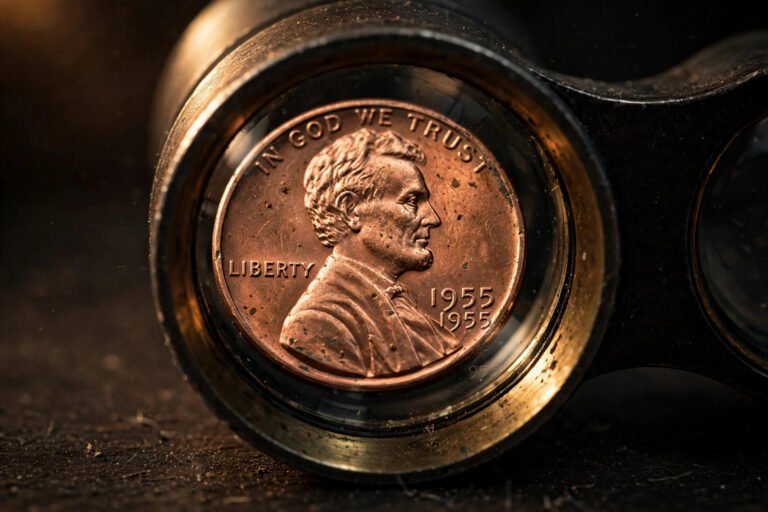
The king of penny errors. The doubling is so bold you can see it without a magnifier: the date, LIBERTY, and IN GOD WE TRUST all appear twice, shifted to the side. It happened when a working die moved slightly between two hub impressions, and thousands of coins were struck before anyone noticed. They mostly entered circulation around New England, and collectors have been hunting them ever since.
What to look for: Strong, rounded doubling on the date and lettering, all shifted the same direction. Flat, shelf-like doubling is machine doubling, not this variety — it adds no value.
Value: Circulated examples start around $1,500. Mint State red coins climb steeply with grade; the auction record is $320,625 for a PCGS MS65+ Red example sold by GreatCollections in February 2025.
2. 1969-S Doubled Die Obverse
The rarest coin on this list and the most faked. A single mis-hubbed die at San Francisco produced strong doubling on the date, LIBERTY, and IN GOD WE TRUST — but not on the S mint mark, which is one way to tell a genuine coin from a fake. Fewer than 100 genuine examples are known. Counterfeits were so common in the 1970s that the Secret Service seized some, and today no dealer will touch an uncertified one.
What to look for: Bold doubling on the obverse lettering with a normal, sharp S mint mark. If the S is doubled too, walk away.
Value: Even heavily worn genuine examples start around $10,000. Very Fine pieces reach $25,000 and more, and certified MS64 Red examples have sold for roughly $98,000 to $127,000 in recent years. The finest known examples have passed $600,000.
3. 1943 Bronze Cent
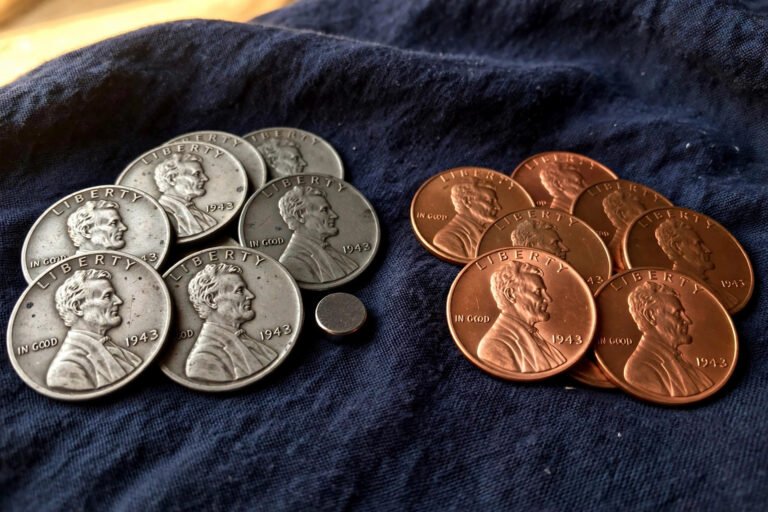
The most famous wrong-metal error in American coinage. In 1943 the Mint struck pennies in zinc-coated steel to save copper for the war. A few bronze planchets left over from 1942 got stuck in feed bins and were struck as 1943 cents. They look brown next to the pale grey steel coins, but many slipped through counting machines anyway.
What to look for: A 1943 penny that does NOT stick to a magnet and weighs 3.11 grams. A normal 1943 steel cent sticks hard to a magnet and weighs 2.7 grams. Beware copper-plated steel fakes — the magnet test catches them, because the steel core still sticks.
Value: Even low-grade genuine examples exceed $100,000. The finest known, a 1943-D bronze cent, sold privately for $1.7 million in 2010. Only a handful are certified across all three mints.
4. 1944 Steel Cent
The mirror image of the 1943 error. When copper returned in 1944, a few leftover steel blanks found their way into the penny presses. Most known examples are from Philadelphia, with Denver and San Francisco pieces rarer still. About 30 to 40 are known in total.
What to look for: A 1944 penny that sticks to a magnet and weighs 2.7 grams instead of 3.11. Altered dates are the commonest trick — compare the date digits against a known genuine coin.
Value: Certified examples run from around $50,000 in circulated grades to six figures in Mint State. The record is $408,000 for a 1944-S graded MS66, sold by Heritage in August 2021. Our full guide to the 1944 steel penny covers the magnet and weight tests in detail: https://thecoinrelics.com/1944-steel-penny-wrong-metal-wheat-cent-worth-real-money/
5. 1992 Close AM Reverse
The modern error on this list, and proof that valuable mistakes still hide in pocket change. In 1992 the Mint changed proof pennies to a Wide AM reverse, with a clear gap between the A and M in AMERICA. A few circulation dies accidentally got the proof-style reverse — but the wrong way round: on these coins the A and M nearly touch.
What to look for: On the reverse, look at AMERICA. On a normal 1992 cent the A and M are clearly separated. On the error, they are close together, almost touching. Check the designer’s initials FG too — on the error they sit further from the Memorial building.
Value: About Uncirculated red-brown examples run around $1,500, and Mint State MS64 coins can reach $10,000. The auction record is $25,850 for a PCGS MS67 Red example sold in 2017.
6. 1983 Doubled Die Reverse
The most affordable dramatic doubled die on this list. After the 1982 switch to copper-plated zinc, one 1983 reverse die was hubbed out of alignment, doubling ONE CENT and E PLURIBUS UNUM so boldly it outshines the 1955 obverse at a glance.
What to look for: Strong doubling on the reverse lettering, especially ONE CENT. The doubling is rounded and raised, not flat and shelf-like.
Value: Circulated XF examples trade around $75 to $125. Red MS63 coins sell for $300 to $450, and top-grade MS67 Reds can exceed $2,500.
7. 1972 Doubled Die Obverse
Three doubled-die varieties exist for 1972, and Die 1 is the prize: the boldest spread, with clear doubling on LIBERTY and IN GOD WE TRUST. Thousands were struck before the die was pulled, so examples turn up in every grade — which is exactly why roll hunters love this one.
What to look for: Strong doubling on LIBERTY and IN GOD WE TRUST, visible with a basic loupe. Learn the Die 1 markers before you buy, because the weaker dies are worth far less.
Value: Fine examples trade around $40. About Uncirculated coins with even red-brown color earn $150 to $250, and MS65 Red examples sell for $1,000 or more.
8. 1995 Doubled Die Obverse
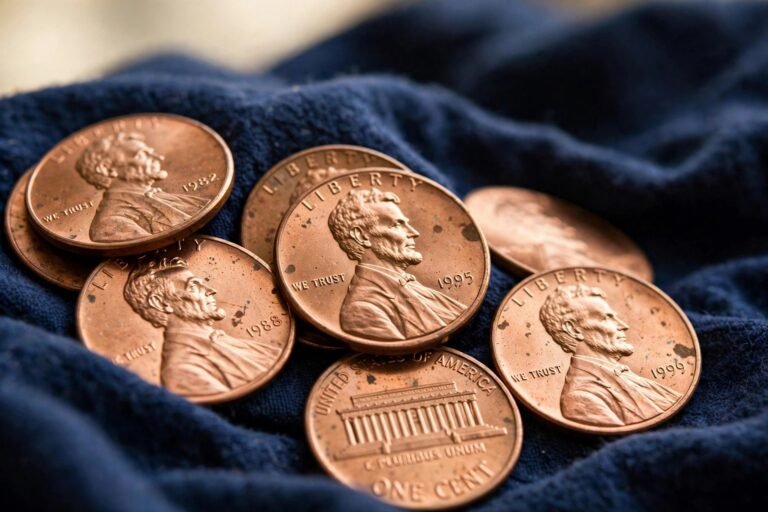
The gateway error — the coin that got thousands of collectors started. The doubling is lighter than the 1955 classic, but it is clear under magnification on LIBERTY and IN GOD WE TRUST. Millions of 1995 pennies are still in circulation, so this is the one you are most likely to actually find.
What to look for: Light but distinct doubling on the obverse lettering. Media coverage in the 1990s sent roll hunters searching, and genuine examples still surface in bank rolls.
Value: Circulated brown pieces sell for $5 to $10. Red MS63 coins earn $25 to $35, and top-graded MS69 Reds can exceed $400.
9. 1982-D Small Date Copper Cent
A transitional error from the year the Mint changed the penny’s metal. Denver struck Small Date cents on zinc planchets — but two coins were struck on leftover bronze planchets instead. Only two examples are known to exist, and the weight test tells the story: bronze weighs 3.11 grams, zinc weighs 2.5.
What to look for: A 1982-D penny with the Small Date design that weighs 3.11 grams. Most 1982-D Small Date cents are zinc and worth face value — the scale is what separates a fortune from a penny.
Value: One certified AU58 example sold for $18,800 at Heritage in August 2017. With only two known, any new discovery would make news. Our guide to the 1982 penny copper or zinc weight test explains the seven 1982 varieties and how to weigh them: https://thecoinrelics.com/1982-penny-copper-or-zinc-the-weight-test-every-beginner-should-know/
10. 1970-S Small Date (High 7)
The subtlest coin on this list. San Francisco struck most 1970 pennies with a Large Date design, but a small batch used Small Date dies — and on those, the 7 in the date sits noticeably higher than the 9, the 0, and the S. Spotting it takes a trained eye and a side-by-side comparison, which is why so many sat unnoticed in collections for years.
What to look for: Compare the height of the 7 against the other digits. On the Small Date variety it floats high. The difference is small, so compare against a confirmed Large Date coin, not from memory.
Value: Very Fine examples trade around $75. Red-brown AU pieces earn $200 to $300, and Red MS65 examples sell for $1,000 to $1,500, with MS66 and MS67 Reds reaching $3,000 and beyond.
Value at a glance
| Error | Circulated | Mint State |
|---|---|---|
| 1955 Doubled Die Obverse | $1,500+ | $40,000+ (Red); record $320,625 |
| 1969-S Doubled Die Obverse | $10,000+ | $98,000–$127,000 (MS64 Red); finest $600,000+ |
| 1943 Bronze Cent | $100,000+ | $1.7 million (finest known, private sale 2010) |
| 1944 Steel Cent | $50,000+ | Record $408,000 (MS66, 2021) |
| 1992 Close AM Reverse | $1,500 (AU) | $10,000 (MS64); record $25,850 |
| 1983 Doubled Die Reverse | $75–$125 (XF) | $300–$450 (MS63); $2,500+ (MS67 Red) |
| 1972 Doubled Die Obverse | $40 (F12) | $150–$250 (AU); $1,000+ (MS65 Red) |
| 1995 Doubled Die Obverse | $5–$10 | $25–$35 (MS63); $400+ (MS69 Red) |
| 1982-D Small Date Copper | Only 2 known | $18,800 (AU58, 2017) |
| 1970-S Small Date | $75 (VF) | $1,000–$1,500 (MS65 Red) |
Values are guide and auction ranges as of November 2026. Condition and color (Red vs. Red-Brown vs. Brown) move every number on this table.
How to check your pennies
Three cheap tools catch almost every error on this list. A 10x loupe shows doubling and date details. A small magnet separates steel from bronze in seconds — steel sticks, bronze does not. A pocket scale that reads to 0.01 grams separates the metals: bronze 3.11 grams, steel 2.7 grams, copper-plated zinc 2.5 grams. Check coins under good light, compare anything odd against verified photos of genuine examples, and remember that a coin has to fail the right test in the right way — a 1943 penny that sticks to a magnet is a normal steel cent, not a treasure.
Fakes and cleaning: the two ways to lose money
The valuable errors are the most faked coins in the hobby. The 1969-S doubled die has convincing counterfeits. 1943 steel cents get copper-plated to fake a bronze cent — the magnet test exposes them. Dates get altered to turn common coins into rare ones. And machine doubling, the flat shelf-like doubling that happens when a die bounces during striking, looks dramatic to a beginner but adds no value at all; true doubled dies show rounded, split lettering.
Never clean a coin you think might be an error. Cleaning scratches the surface and strips original color, and graders will mark the coin as cleaned — cutting its value by most of its worth. Present any suspect coin exactly as found.
What to do if you find one
Do not clean it, do not spend it, and do not announce it on social media before it is authenticated. Run the magnet and weight tests, photograph both sides, and contact PCGS or NGC about certification. No dealer or auction house pays serious money for an uncertified rarity, and certification is what separates a life-changing find from a clever fake. For the full story on the wartime wrong-metal errors, our guide to the 1943 steel vs copper penny walks through the magnet test step by step: https://thecoinrelics.com/1943-steel-penny-vs-1943-copper-penny-the-magnet-test-that-tells-them-apart/
FAQ
Can I still find these errors in circulation?
Yes — the modern ones, especially the 1992 Close AM and the 1995 doubled die, still surface in bank rolls and pocket change. The 1955 doubled die and the wartime wrong-metal errors almost never appear in circulation anymore, but they do turn up in old collections, inherited jars, and estate lots.
What is the difference between a doubled die and machine doubling?
A doubled die comes from the die itself: the hubbing process doubled the design, so every coin from that die shows the same rounded, split doubling. Machine doubling happens during striking, when the die shifts slightly — it looks flat and shelf-like, varies from coin to coin, and adds no value.
Should I clean an error penny to show the details better?
No. Cleaning scratches the metal and removes original surface color, which lowers both the grade and the value. Present the coin as found when you submit it for professional review.
Where do I sell a valuable error penny?
Get it certified by PCGS or NGC first, then sell through a major auction house like Heritage or Stack’s Bowers, or a reputable error-coin dealer. Certified coins reach far more buyers and far higher prices than raw ones.
Values are estimates based on grade, authenticity and current market demand at the time of writing. A cleaned, damaged or counterfeit coin is worth far less. Get valuable coins certified by PCGS or NGC.