1982 Penny: Copper or Zinc? The Weight Test Every Beginner Should Know
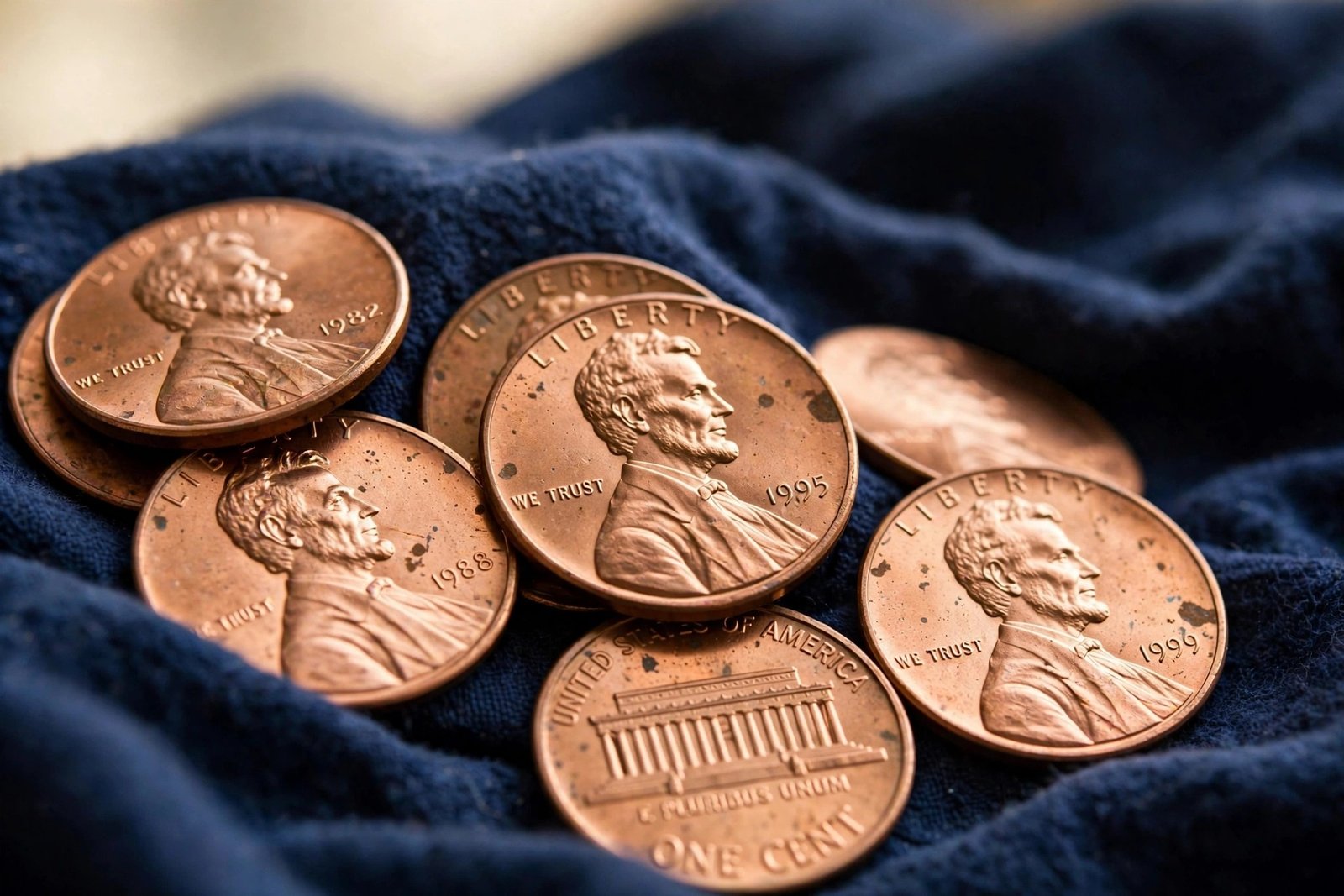
Pick up a handful of pennies and you will almost certainly find a 1982. It looks ordinary, but 1982 is the year the penny’s metal changed mid-production. Some 1982 pennies are mostly copper; others are mostly zinc with a thin copper skin. They look alike, yet a cheap scale tells them apart in seconds.
That is the simplest lesson in coin identification — date, mint mark and weight, checked together — and it leads to one famous exception: a Denver penny, with a Small Date, struck on copper, which should not exist at all. The confirmed example that reached auction sold for $18,800. Your 1982 penny almost certainly is not that coin. Learning how to prove that is the skill this guide teaches.
The weight test: a 1982 copper cent weighs about 3.11 grams; a copper-plated zinc cent weighs about 2.50 grams. A digital scale reading to 0.01 grams is the reliable tool — colour alone tells you nothing, because zinc cents are plated to look copper-coloured. The seven regular varieties: 1982 produced seven circulation varieties, from mint mark (no mint mark or D), date size (Large or Small Date) and metal (copper or zinc) — with the 1982-D Small Date copper missing from the regular set. The rare one: only a 1982-D Small Date cent that is also copper — all three facts together — is the famous transitional error. Two examples have been confirmed.
Why 1982 changed the penny
For decades the Lincoln cent was bronze: 95% copper and 5% zinc. By the late 1970s, copper had risen above a dollar a pound, and the metal in a cent was approaching its face value. The Mint’s answer, introduced during 1982, was a copper-plated zinc cent: a zinc core of about 97.5%, with a thin copper plating of about 2.5%. The new coin weighed 2.5 grams instead of 3.11 grams, and it has been the standard cent composition ever since.
Production was enormous: 10,712,525,000 no-mint-mark cents and 6,012,979,368 Denver cents, a combined 16,725,504,368 — the largest single-year cent production ever, according to CoinWorld. Ordinary 1982 pennies are therefore common, and nobody should pay a premium for a random circulated one. One caution: this guide says “no mint mark” rather than naming a mint, because no-mint-mark 1982 cents were struck at more than one facility and cannot be told apart. The D mint mark, below the date, means Denver.
The seven varieties of 1982
Because the metal and the date design both changed in 1982, the year produced seven regular circulation varieties — a cheap set to build from change:
| Variety | Metal | Weight |
|---|---|---|
| No mint mark, Large Date | Copper | 3.11 g |
| No mint mark, Small Date | Copper | 3.11 g |
| No mint mark, Large Date | Zinc (copper-plated) | 2.50 g |
| No mint mark, Small Date | Zinc (copper-plated) | 2.50 g |
| 1982-D, Large Date | Copper | 3.11 g |
| 1982-D, Large Date | Zinc (copper-plated) | 2.50 g |
| 1982-D, Small Date | Zinc (copper-plated) | 2.50 g |
Notice the gap: no regular 1982-D Small Date copper cent. That gap is where the story gets interesting — the copper 1982-D Small Date is a transitional error, not an eighth regular variety.
How to do the weight test
You need a digital scale reading to at least 0.01 grams; pocket jewellery or kitchen scales work fine and cost only a few dollars. A bathroom scale will not do it, as the difference is only about six-tenths of a gram.
- Zero the scale, and check it with a known coin — a post-1982 zinc cent should read close to 2.50 grams.
- Weigh the 1982 cent alone. Near 3.11 grams points to copper; near 2.50 grams points to zinc.
- Allow a little tolerance. Wear removes metal, so a worn copper cent can read slightly under 3.11 grams; the second confirmed 1982-D Small Date copper coin was labelled at 3.07 grams, within reasonable tolerance. A reading of 2.9 grams or above on a 1982-D Small Date coin deserves a second look; 2.50 grams is zinc, full stop.
- Record all three facts together: date size, mint mark and weight, before moving to the next coin.
Collectors also mention a sound test — copper rings more clearly than zinc when dropped gently on a hard surface. Treat that as a hint only, never proof. Weight, date and mint mark together are the check.
Large Date vs Small Date: what to look for
Compare the “2” and the “8” in the date, under magnification or a phone camera zoom:
- Large Date: the “2” has a thick, straight base, and the “8” is wider, with a lower loop noticeably larger than its upper loop.
- Small Date: the “2” has a delicate, curved base, and the “8” is slimmer, with a round upper loop closer in size to the lower loop.
Learn this from two coins side by side, not one alone — both types are common. Note that these tells are specific to 1982; use a 1982 reference, not rules borrowed from another year.
What a 1982 penny is worth
Most circulated 1982 pennies are worth face value to a small premium, and dealers buy ordinary examples by the roll. The table below covers the regular varieties only.
| Coin | Circulated (estimate) | Uncirculated (estimate) |
|---|---|---|
| Common 1982 copper varieties | Face value to about 25 cents | Commonly a few dollars in high grades |
| Common 1982 zinc varieties | Face value to about 25 cents | Commonly a few dollars; the Small Date zinc is the priciest regular variety in top grades, cited up to around $9 |
| Full seven-variety circulated set | A few dollars from change and dealer bins | Higher as a matched uncirculated set, but still modest |
These are commonly cited guide ranges, not buy prices, and condition is everything. Zinc cents also have a weakness copper cents do not: the thin plating can bubble or corrode in damp storage. Handle cents by their edges and store them dry, as our guide to coin mistakes explains
The rare one: the 1982-D Small Date copper cent
Denver switched to zinc before the Small Date die was introduced there, so a Small Date cent from Denver should always be zinc. But a few leftover copper planchets — the blank discs coins are struck on — were still in the system, and at least two were struck with the Small Date die at Denver. The result is a transitional off-metal error, in the same family as the famous 1943 copper cents
Only two examples have been confirmed. The discovery coin, found by Minnesota collector Paul Malone and reported in January 2017, was graded AU58 by NGC; as lot 2031 in Stack’s Bowers’ August 2017 Rarities Night auction it realised $18,800. A second coin, also AU58 (PCGS, labelled 3.07 grams), was reported by Numismatic News in May 2019. That $18,800 is one auction result from 2017 for one authenticated coin — not a current price, and not a promise about what another example would bring.
The checklist is strict, and every item must be true at once: a D mint mark below the date; a Small Date; a copper weight around 3.11 grams, not 2.50 grams; and PCGS or NGC authentication before any value claim. If any item fails, you have a regular 1982 cent: a 1982-D Small Date at 2.50 grams is the ordinary zinc variety, worth face value in circulation, and a 1982-D Large Date at 3.11 grams is the ordinary copper variety. Only the combination is rare.
Fakes, cleaning and other warnings
This story invites wishful thinking — treating a copper-coloured 1982-D Small Date as the error without weighing it, or a scale reading alone as proof — and outright fakery, since copper-plated zinc cents can be made to look like solid copper. Our wheat penny guide shows how often altered coins appear on valuable dates; apply the same scepticism here, and treat an uncertified “rare” 1982-D Small Date copper at a bargain price as guilty until a grading service proves it innocent.
Never clean a 1982 cent to “check” its metal. Cleaning strips original surfaces, leaves hairline scratches, and can cut value in half or worse — and on a zinc cent it can damage the plating itself. A dirty coin that might be interesting is worth far more dirty than cleaned.
What to do if you find a 1982 penny worth a second look
- Note the date size, mint mark and weight, and photograph both sides.
- Put it in a holder or envelope straight away — do not clean or polish it.
- Re-check the weight on a second scale if you can, and compare the date against known Large and Small Date examples.
- If — and only if — you have a 1982-D Small Date coin weighing around 3.11 grams, contact PCGS or NGC about authentication before telling anyone it is valuable or offering it for sale.
- Otherwise, enjoy the set: a complete seven-variety 1982 collection from change is one of the cheapest, most satisfying beginner projects in coin collecting.
Most 1982 pennies will be ordinary, and that is fine. Once you can weigh a cent, read its date style and name its mint mark, you can apply the same three checks to wheat cents, error coins and silver coins — and never again guess what a penny is made of.
How can I tell if my 1982 penny is copper or zinc without a scale?
You cannot, reliably. Colour fails, because zinc cents are copper-plated to look identical, and the sound test is only a hint. A scale reading to 0.01 grams settles it: about 3.11 grams is copper, about 2.50 grams is zinc.
Are all 1982 pennies without a mint mark from Philadelphia?
No. No-mint-mark 1982 cents were struck at more than one facility and cannot be told apart, so the accurate description is simply “no mint mark.” Only the D identifies a coin as Denver.
What is the difference between a Large Date and a Small Date 1982 penny?
Look at the “2” and the “8.” On a Large Date, the “2” has a thick, straight base and the “8” has a much larger lower loop. On a Small Date, the “2” has a delicate curved base and the “8” is slimmer, with loops closer in size.
Is a 1982-D Small Date penny always valuable?
No. The ordinary 1982-D Small Date cent is zinc, weighs 2.50 grams and is worth face value in circulation. Only a 1982-D Small Date struck on a copper planchet — around 3.11 grams — is the rare transitional error, and only two examples have been confirmed. It needs PCGS or NGC authentication before any value claim.
Values are estimates based on grade, authenticity and current market demand at the time of writing. A cleaned, damaged or counterfeit coin is worth far less. Get valuable coins certified by PCGS or NGC.