Kennedy Half Dollars: Which Years Are 90% Silver, Which Are 40%?
Kennedy Half Dollars: Which Years Are 90% Silver, Which Are 40%?
Kennedy half dollars are the easiest silver coins in America to overlook. Banks still hand them out, many shops treat them as awkward change — and the first several years of the series were struck in real silver, in two different purities that confuse almost everyone at first.
Get the years right and the sorting is simple. One year is 90% silver. Five years are 40% silver. Everything made for circulation after that carries no silver at all, with a few collector-only exceptions worth knowing.
Quick answer
90% silver: 1964 only — 12.5 grams total, 0.3617 troy ounces of pure silver
40% silver: 1965 through 1970 — 11.5 grams, 0.1479 troy ounces of pure silver
No silver: 1971 to date, for circulation coins
Collector exceptions: 1970-D (mint sets only), 1976-S 40% Bicentennial issues, and silver proofs from 1992 onward
Fastest check: the edge. Silver and 40% coins show no copper stripe; clad coins do.
Keep those lines beside your coin jar and you will never spend a silver Kennedy by accident.
A coin born from a national tragedy
President John F. Kennedy was assassinated on 22 November 1963. Within weeks, Congress authorised a half dollar in his memory, and the new coin reached the public in early 1964. The portrait by Gilroy Roberts shows Kennedy in profile; Frank Gasparro adapted the presidential seal for the back.
Americans saved the coin from day one as a keepsake rather than spending it, and the Kennedy half began its long drift out of everyday circulation. Because so many 1964 halves were saved, uncirculated examples are plentiful. The real beginner skill is telling the three metal types apart with total confidence.
The three metals, year by year
1964 — the one true silver year
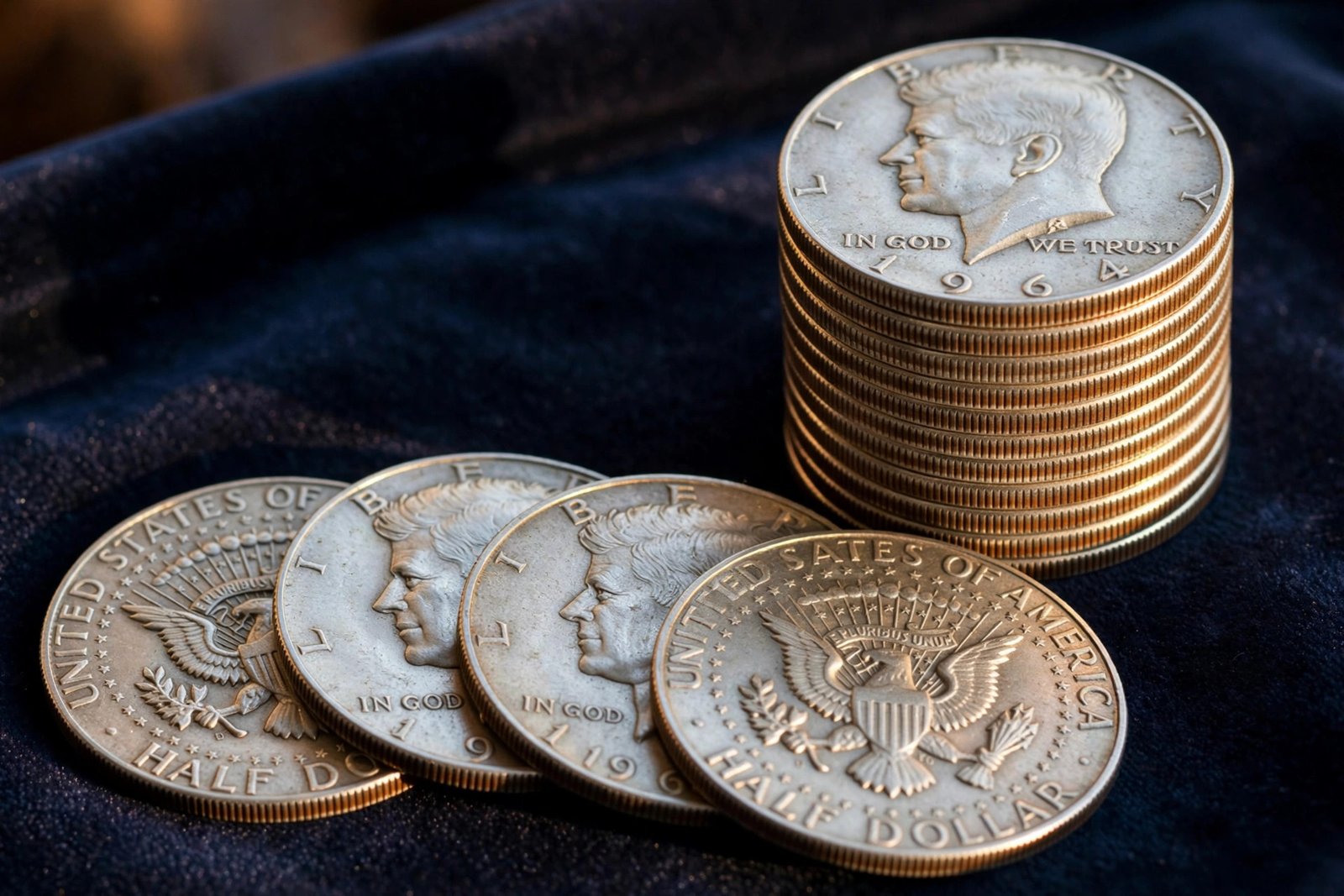
Every Kennedy half dollar dated 1964 was struck in the classic coin silver alloy: 90% silver, 10% copper. Total weight is 12.5 grams, and each coin holds 0.3617 troy ounces of pure silver. That is exactly the same standard the United States had used for its dimes, quarters, and halves for generations.
One detail catches people out. On 1964 coins, the mint mark is on the back of the coin, to the left of the eagle’s tail feathers, near the claw. Denver coins carry a D there; Philadelphia coins have no mark.
1965–1970 — the 40% silver-clad years
When silver prices forced the Mint to cut costs, the half dollar kept some silver while dimes and quarters lost all of theirs. From 1965 to 1970, Kennedy halves were a sandwich: outer layers rich in silver bonded to a mostly copper core, averaging 40% silver overall.
These coins weigh 11.5 grams and contain 0.1479 troy ounces of pure silver each — real silver, worth well over face value, and the coins most often spent by mistake. Within this run, remember one special coin: the 1970-D was struck only for mint sets, never released into circulation, so any example deserves to be kept.
1971 onward — copper-nickel clad
From 1971, circulation Kennedy halves switched to the same copper-nickel clad metal as modern dimes and quarters: no silver, weight 11.34 grams. Their edges show the familiar copper core stripe clearly.
Two collector exceptions stand outside that rule. For the Bicentennial, the Mint sold special 1976-S Kennedy halves in 40% silver for collector sets. And from 1992 to the present, silver proof Kennedy halves have been included in silver proof sets — 90% silver in the early years of that programme and 99.9% fine silver in modern issues. Those proofs carry an S mint mark and a mirror finish, so you will rarely meet one loose in change.
Kennedy half dollar value table
Common silver Kennedys trade mainly on metal content, so their prices move with the silver market. Certified high-grade and proof coins are the exception.
| Grade | Approx. value |
|---|---|
| 1964, circulated (90% silver) | Silver-driven — well over face, varies with spot |
| 1964, uncirculated (90% silver) | Modest premium over silver value |
| 1965–1970, circulated (40% silver) | Silver-driven — several dollars each, varies with spot |
| 1970-D, mint set quality (40% silver) | $15–$30 |
| 1971 onward, circulation strike | Face value (50 cents) |
| Silver proof, 1992 onward | Collector premium over silver value, varies by year |
What to look for — your checklist
- Sort by date first. 1964 goes in the 90% pile. 1965–1970 goes in the 40% pile. 1971 and later goes back to the spend pile, unless it is a proof.
- Check the edge. Silver and 40% coins show a silvery edge with no bold copper stripe. Clad coins flash an obvious copper-coloured core.
- Weigh the maybes. Expect 12.5 grams for a 1964, 11.5 grams for a 1965–1970 coin, and about 11.34 grams for a later clad coin. A gram scale settles arguments instantly.
- Find the mint mark in the right place. For 1964, look on the back, to the left of the eagle’s tail feathers. From 1968 onward, the mint mark moved to the front, above the date between the rim and Kennedy’s bust. Coins from 1965–1967 carry no mint marks at all, whichever mint made them.
- Spot the proofs. Mirror-like fields, frosted designs, and an S mint mark signal a collector proof — including the valuable silver proofs from 1992 onward. Keep proofs in their holders.
- Save every 1970 coin you see. Check for the D. The 1970-D came only from mint sets and carries a clear premium.
Fakes, plated coins, and honest mistakes
Kennedy halves are faked less often than key-date rarities, but the silver years still attract tricks. The most common is a silver-plated clad coin: plating changes the look, not the metal, so the weight stays at clad level and the edge often shows copper colour breaking through. Altered dates exist too, usually a changed digit trying to turn a clad-era coin into a 1964.
Weight plus edge plus date is a strong three-part test. If a valuable-looking coin fails any one of them, get a dealer opinion before paying silver money.
What to do if you find one
- Pull every Kennedy half dated 1970 or earlier out of your change and bank rolls before you spend anything.
- Split them into 1964 and 1965–1970 piles, then confirm each pile with the edge and weight checks.
- Set any 1970-D and any mirror-finish proof aside in holders, handled only by the edges.
- Do not clean your coins. Silver Kennedys are valued for metal and originality, and cleaning adds nothing to either.
- Value the common silver dates using the live silver spot price and the pure-silver weights in this guide: 0.3617 ounces for 1964 coins, 0.1479 ounces for 40% coins.
- Roll-hunt patiently if you enjoy the search. Banks can order half dollar boxes, and silver still turns up in them.
When you are ready for the quarters, continue with Are Your Quarters Silver? Every Washington Quarter Date to Look For (1932–1964), and for the flagship coin, see the Morgan Silver Dollar Value Guide: Key Dates From 1893-S to 1921.
FAQ
Are 1970 Kennedy half dollars silver?
Yes, partly. Kennedy halves dated 1970 are 40% silver, like the other 1965–1969 issues, and each contains 0.1479 troy ounces of pure silver. The 1970-D is especially worth keeping because it was struck only for mint sets and never released into circulation.
How can I tell a 40% silver Kennedy from a regular clad one?
Use the edge and a scale. A 40% silver coin from 1965–1970 shows no bold copper stripe on its edge and weighs 11.5 grams. A clad coin from 1971 onward shows a clear copper core on the edge and weighs about 11.34 grams. The date confirms which group a coin belongs in.
Are Bicentennial Kennedy half dollars worth more than face value?
Ordinary 1976 circulation coins are copper-nickel clad and worth face value. The exception is the special 1976-S version struck in 40% silver for collector sets, which carries a premium. Check the mint mark and finish — the silver version came from San Francisco in collector packaging.
Where is the mint mark on a Kennedy half dollar?
It depends on the year. On 1964 coins it is on the back, to the left of the eagle’s tail feathers. Coins from 1965–1967 have no mint mark. From 1968 onward, the mint mark sits on the front of the coin, above the date, between the rim and the bottom of Kennedy’s bust.
Values are estimates based on grade, authenticity and current market demand at the time of writing (October 2026). A cleaned, damaged or counterfeit coin is worth far less. Get valuable coins certified by PCGS or NGC.