Silver Just Fell Below $55 an Ounce — What That Means for Your Old Silver Coins
Silver just had one of its worst days of the year — and Google noticed. Search interest for “silver price” in the United States spiked on October 22, 2026, peaking that afternoon, and the rising queries told the story: “why silver price is falling” broke out and “why is silver going down” jumped 900% (Google Trends, United States, past day).
If you keep old silver coins — the kind sitting in jars, inherited tins, and bank rolls nobody has sorted — a sharp price drop rewrites the math on every one of them. Here is what happened, what your coins are actually worth right now, and what to do about it.
Quick answer
What happened: COMEX silver settled at $54.764 an ounce on October 22, 2026, down 4.63% in a single day — the biggest one-day drop since October 14, and the lowest settlement since November 26, 2025 (Dow Jones Market Data, via Morningstar).
The bigger picture: silver is now roughly 52% below its January 26, 2026 record high of $115.08, and down about 21.9% so far this year.
What it means for your coins: a common 90% silver quarter now holds roughly $9.90 in metal — about half what it held at the start of the year. Dealers pay below melt. Rarity still beats metal on key dates.
Why silver fell
This slide had nothing to do with coins. On October 22, a renewed surge in crude oil — Brent climbing above $108 a barrel on Middle East escalation — revived inflation fears and bets on further Federal Reserve tightening, with the October 28 FOMC decision looming. Speculative money fled silver futures: the classic rates-driven repricing of an asset that pays no yield (USAGOLD daily precious metals market report, October 22, 2026).
Gold fell too, easing to about $4,084 an ounce, but silver fell much harder. The gold-to-silver ratio widened to roughly 73, a sign of silver’s sharper reaction to rate news. Notably, the selling was paper-and-futures selling — not a collapse in physical coin and bar demand — and lower spot resets the entry point for buyers who were priced out above $4,200 gold.
Silver’s wild 2026
Some perspective helps. Silver hit a record $115.08 on January 26, 2026. At that level, a single common 90% silver quarter carried over $20 in melt value, and a Morgan dollar over $88. Since then the metal has given back more than half its value, and on a month-to-date basis it is down about 8.9%.
This is simply how silver behaves — it swings far more violently than gold in both directions. The lesson for coin owners is not to panic and not to celebrate. It is that melt value is a moving target, and the “worth” of a common silver coin breathes with the spot price every trading day.
What your silver coins are worth now
The figures below use the October 22, 2026 COMEX settlement of $54.764 an ounce, rounded. They are metal value only — the ceiling a dealer or refiner starts from, not what you will be paid. Dealers pay below melt to cover their costs and risk, and scarce dates are worth far more than metal.
| Coin | Pure silver content | Rough melt value |
|---|---|---|
| 90% silver quarter, 1932–1964 | 0.1808 oz | ~$9.90 |
| 90% silver dime, Mercury or Roosevelt, pre-1965 | 0.0715 oz | ~$3.92 |
| 90% silver half dollar, pre-1965 | 0.3617 oz | ~$19.81 |
| 40% silver Kennedy half, 1965–1970 | 0.1479 oz | ~$8.10 |
| Morgan or Peace silver dollar | 0.7734 oz | ~$42.35 |
| 1 oz silver round or bullion Eagle | 1.0000 oz | ~$54.76 |
A jar of 40 common silver quarters, for instance, holds about $396 in silver at this price — real money, but roughly half of what the same jar held in January. Learn the full routine for spotting silver quarters here.
What to look for — your checklist
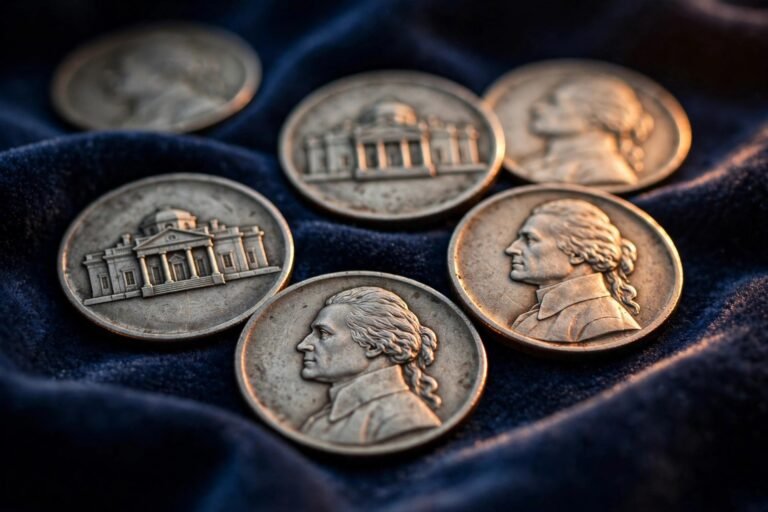
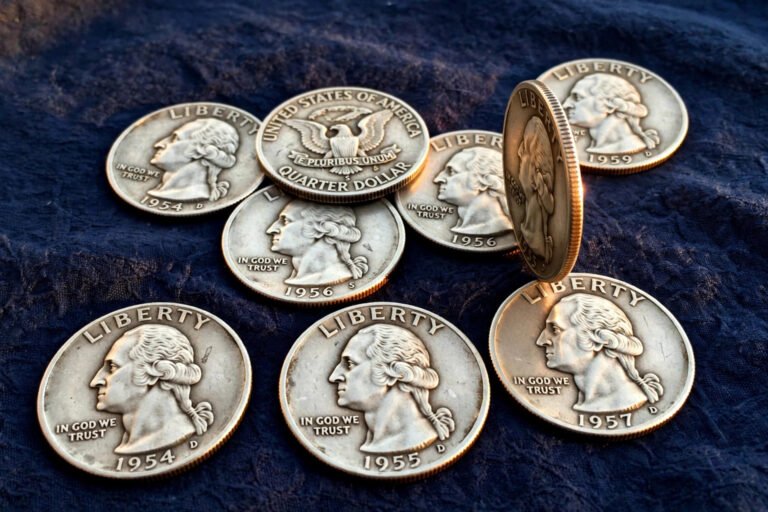
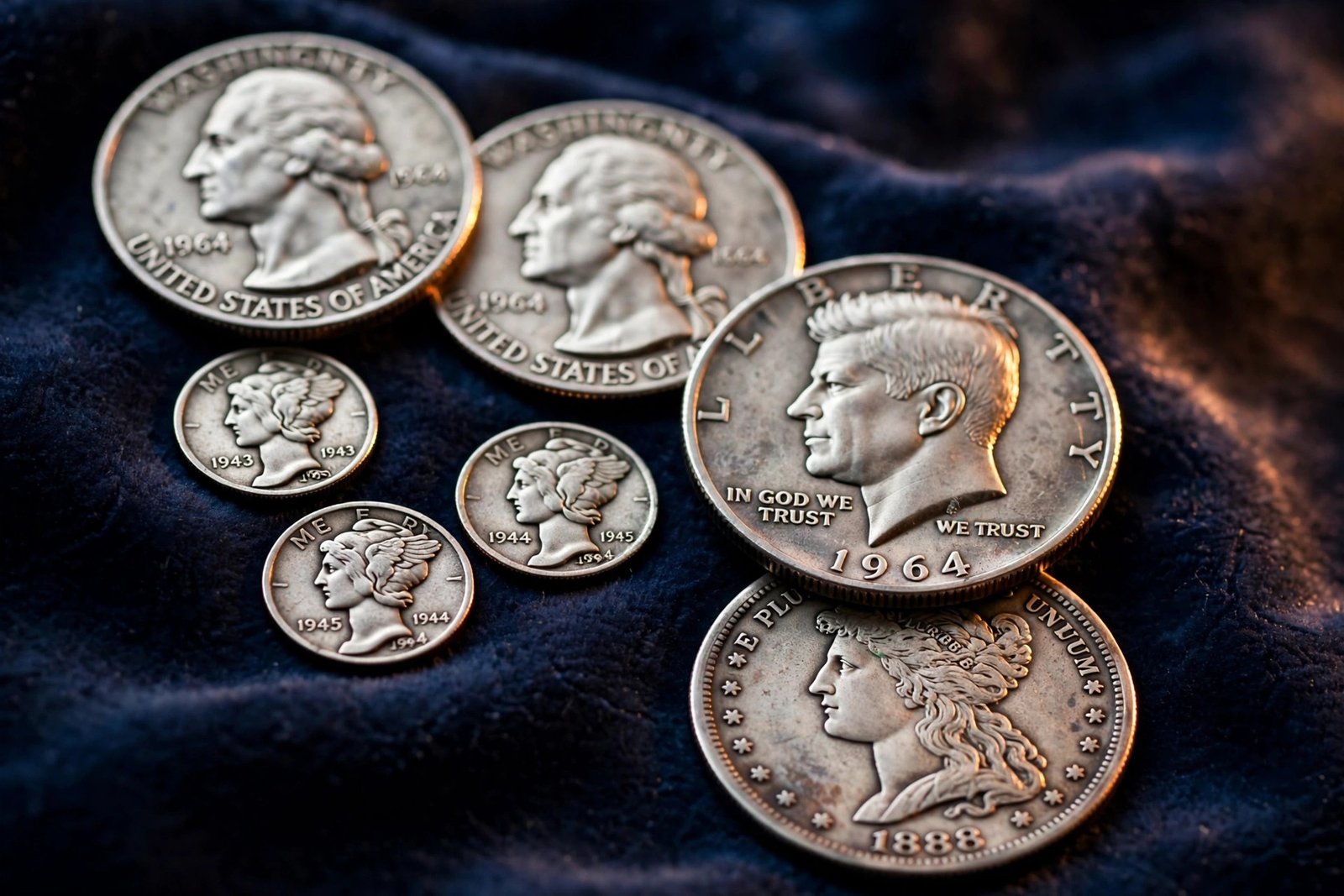
- Start with the dates. 1964 and earlier for quarters, dimes, and half dollars means 90% silver. Kennedy halves dated 1965–1970 are 40% silver, and anything 1971 or later is clad.
- Check the edge. A solid silvery edge with no copper stripe confirms silver content on quarters and dimes.
- Weigh, don’t guess. A 90% silver quarter weighs 6.25 grams; a clad one weighs 5.67 grams. The gap is easy to feel on a small digital scale.
- Separate the key dates first. A 1932-D quarter or 1916-D Mercury dime is a rarity story, not a metal story — silver’s drop barely dents their value. Never sell key dates as junk silver. Our Kennedy half guide shows which years actually contain silver.
- Find the mint mark. On silver Washington quarters it sits on the reverse; on Mercury dimes it is near the fasces on the reverse. Low-mintage issues carry premiums far above melt.
Warnings: dealers, fakes, and cleaning
Dealers pay below melt. The table above is a ceiling, not a quote. Expect offers meaningfully under melt value for common coins, and get more than one offer for anything substantial. Our guide to selling coins safely walks through the dealer-vs-auction choice.
A falling price does not make cleaning okay. Never clean a silver coin to make it “look better” — cleaning destroys collector value instantly and permanently. Tarnish on an old coin is normal; leave it alone.
Watch for silver-plated fakes. When metal prices move, plated counterfeits circulate more. The weight and edge tests catch nearly all of them. Anything genuinely valuable should go to PCGS or NGC for certification.
What to do if you find silver coins
- Sort by date and denomination using the checklist above, keeping 1964-and-earlier coins separate from spendable change.
- Pull out anything that might be a key date before you think about metal value.
- Compute rough melt with the current spot price — it changes daily — by multiplying pure-silver ounces by spot.
- Get offers from at least two reputable dealers, and consider an auction for genuinely rare pieces.
- Do not rush. A single bad day in the silver market is not a deadline; the metal has swung more than 50% this year alone.
FAQ
Is it a bad time to sell my silver coins?
Nobody can answer that for you — this blog does not give investment advice. What we can say is that common silver coins hold about half their January melt value, so selling now locks in the lower metal value. Rare coins are a different market entirely.
Why did silver fall so much in one day?
Futures selling driven by oil-price and interest-rate fears, not a change in coin or industrial demand. Silver is a small, volatile market where speculative money moves prices fast in both directions.
Should I buy silver coins now that the price dropped?
We do not give buying advice. Understand that you will pay a premium over spot for any finished coin, and that common coins track the metal while rare coins track collectors.
How do I check the silver price myself?
Use a live spot-price source and note the date and time — silver moves through the trading day. COMEX settlement prices, like the $54.764 figure used here, are set once daily.
Values are estimates based on grade, authenticity and current market demand at the time of writing. A cleaned, damaged or counterfeit coin is worth far less. Get valuable coins certified by PCGS or NGC.