Gold Just Fell Below $4,000 an Ounce — What That Means for Your Old Gold Coins
Gold Just Fell Below $4,000 an Ounce — What That Means for Your Old Gold Coins
Google Trends noticed before most people did. Search interest for “gold price” in the United States spiked on October 23, 2026, hitting the maximum interest level (100) that evening — the highest reading of the entire week, and well above the 63 seven-day average (Google Trends, United States, past 7 days). A related query, “gold and silver price decline,” surged 3,950%.
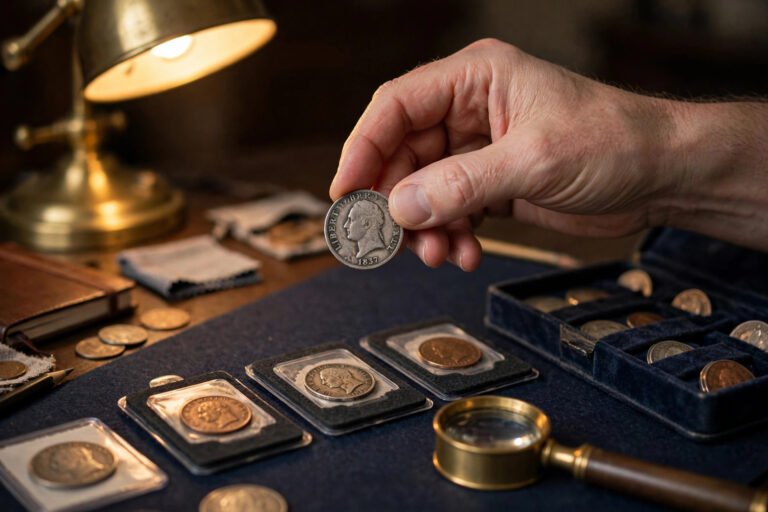
The reason is simple: gold fell through the psychologically huge $4,000-an-ounce line on Friday, October 23, for the first time since mid-July. If you keep old gold coins — an inherited double eagle, a grandfather’s $5 piece, a tube of Gold Eagles — that move rewrites the math on every one of them. Here is what happened, what your coins are actually worth now, and what to do about it.
Quick answer
What happened: COMEX front-month gold settled at $3,991.10 an ounce on Friday, October 23, 2026, down $51.70 (1.28%) on the day and 4.05% on the week — the largest one-week decline since the week ending June 5, 2026, and the lowest settlement since July 16, 2026 (Dow Jones Market Data, via Morningstar).
The bigger picture: gold is now roughly 25% below its record $5,318.40 high from January 29, 2026, and down about 7.7% so far this year. Intraday it touched about $3,986.85 on Friday, the first sub-$4,000 print since July 20 (Refinitiv/Seeking Alpha).
What it means for your coins: a common $20 double eagle now holds about $3,870 in gold — roughly $1,250 less metal value than at January’s peak. A 1 oz American Gold Eagle is worth its weight: about $4,000 in metal, plus a dealer premium. Dealers pay below melt. Rarity still beats metal on key dates.
Why gold fell
This slide had nothing to do with coins. On Thursday, a renewed tech selloff — the Nasdaq fell 2.6%, its worst day since June, on revived worries about AI spending — triggered what one ETF strategist called a liquidity-driven selloff: investors sold gold to cover margin calls elsewhere (Global X ETFs’ Justin Lin, via Bloomberg). The US dollar pushed toward multiyear highs ahead of the Federal Reserve’s October 27–28 meeting, where officials are expected to hold rates steady but with traders pricing roughly 80% odds of a hike in December (CME FedWatch). Surging oil — Brent at a four-year high after Houthi attacks in Saudi Arabia — revived inflation fears, reinforcing the higher-for-longer rates story that punishes a yield-less asset like gold (TradingView/Seeking Alpha, October 23, 2026).
Silver fell alongside, settling Thursday at $54.62 and marking its lowest level since November 2025 (Morningstar) — we covered that drop and its effect on silver coins yesterday.
Gold’s wild 2026
Some perspective helps. Gold hit a record $5,318.40 on January 29, 2026. At that level, a single common $20 double eagle carried over $5,140 in melt value, and a 1 oz Gold Eagle over $5,318. Since then the metal has given back a quarter of its value, and on a month-to-date basis it is down about 4%.
Gold rarely moves this fast in this direction. The lesson for coin owners is the same one silver taught yesterday: melt value is a moving target, and the “worth” of a common gold coin breathes with the spot price every trading day. Do not panic, do not celebrate — understand the math.
What your gold coins are worth now
The figures below use roughly $4,000 an ounce (the October 23, 2026 settlement), rounded. They are metal value only — the ceiling a dealer or refiner starts from, not what you will be paid. Dealers pay below melt to cover their costs and risk, and scarce dates are worth far more than metal. US gold coins minted before 1933 are 90% gold (10% copper); the actual gold weight is what matters.
| Coin | Pure gold content | Rough melt value |
|---|---|---|
| $20 double eagle, pre-1933 (e.g. Saint-Gaudens) | 0.9675 oz | ~$3,870 |
| $10 eagle, pre-1933 | 0.48375 oz | ~$1,935 |
| $5 half eagle, pre-1933 | 0.241875 oz | ~$968 |
| $2.50 quarter eagle, pre-1933 | 0.12094 oz | ~$484 |
| $3 gold piece | 0.1451 oz | ~$580 |
| $1 gold dollar | 0.0494 oz | ~$198 |
| 1 oz American Gold Eagle, 1986–date | 1.0000 oz | ~$4,000 (plus premium) |
| 1 oz American Gold Buffalo, 2006–date | 1.0000 oz | ~$4,000 (plus premium) |
| 1/10 oz American Gold Eagle | 0.1000 oz | ~$400 (plus premium) |
Two things jump out. First, the $20 on the face is almost meaningless: a double eagle’s metal is worth about 194 times its face value. Second, modern bullion Eagles trade at melt plus a premium (recently around 2%), so a 1 oz Gold Eagle sells for more than $4,000 at a dealer even today — while a worn pre-1933 coin sells at a discount to melt because dealers must refine or resell it. Our guide to selling coins safely walks through the dealer-vs-auction choice.
What to look for — your checklist
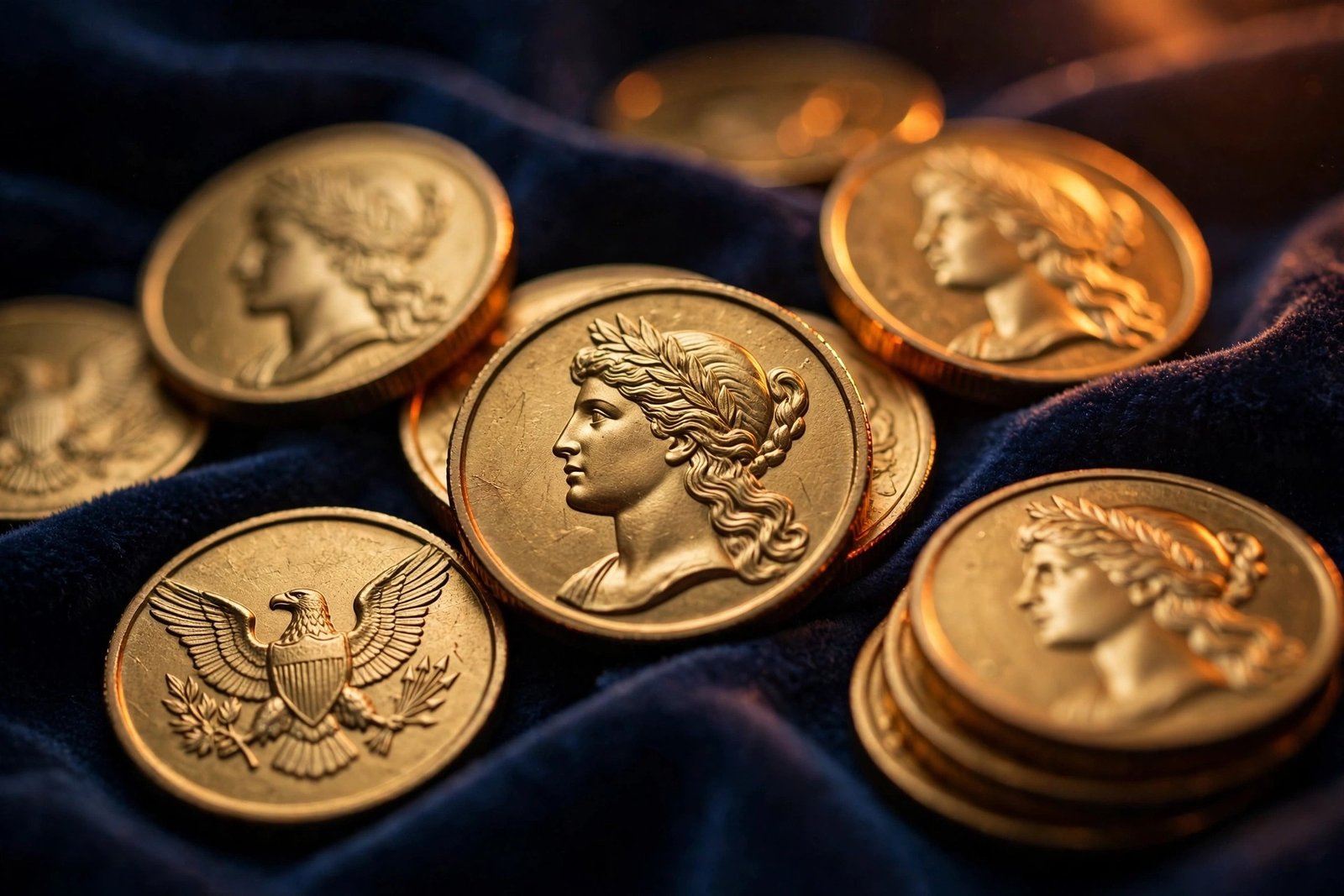
- Start with the dates. US circulating gold coins run 1795–1933 (the government recalled gold coinage in 1933). Modern US Mint gold — Gold Eagles (since 1986) and Gold Buffalos (since 2006) — is bullion and worth melt plus premium.
- Know the denominations. $20, $10, $5, $2.50, $3, and $1 gold pieces all exist. The denomination times the gold weight above gives you the melt floor.
- Weigh, don’t guess. A $20 double eagle weighs 33.44 grams (0.9675 oz of pure gold). A cheap digital scale and the gold weights above defeat most fakes — tungsten-filled counterfeits are the classic gold scam because tungsten nearly matches gold’s density, so weight alone is not enough for high-value pieces.
- Check the mint mark. On pre-1933 gold it appears on the obverse or reverse depending on the series; branch-mint issues (CC for Carson City, O for New Orleans, D for Dahlonega or Denver) can carry real premiums over melt.
- Separate the key dates first. A 1907 High Relief double eagle or an 1879 $4 Stella is a rarity story, not a metal story — gold’s drop barely dents their value. Never sell key dates as melt gold.
- Understand premiums vs. melt. Modern Gold Eagles command a premium over melt because they are liquid and trusted. Worn 19th-century gold sells below melt. That gap is normal.
Warnings: dealers, fakes, and cleaning
Dealers pay below melt. The table above is a ceiling, not a quote. Expect offers meaningfully under melt for common pre-1933 gold, and get more than one offer for anything substantial.
Never clean a gold coin. Cleaning destroys collector value instantly and permanently, no matter the metal price. An old coin’s original surfaces are part of its value; leave them alone.
Watch for fakes. Gold’s price — still near $4,000 an ounce — makes counterfeits worth forging. Plated base-metal coins are caught by a scale and a magnet (gold is not magnetic), but tungsten-core fakes need professional testing. Anything genuinely valuable should go to PCGS or NGC for certification before it is sold.
What to do if you find gold coins
- Sort by denomination and date using the checklist above, keeping pre-1933 coins separate from modern bullion pieces.
- Pull out anything that might be a key date before you think about metal value — rarity can dwarf melt.
- Compute rough melt with the current spot price — it changes daily — by multiplying pure-gold ounces by spot.
- Get offers from at least two reputable dealers, and consider an auction for genuinely rare pieces.
- Do not rush. A sharp week in the gold market is not a deadline; the metal has swung about 25% from its January high this year alone.
FAQ
Is it a bad time to sell my gold coins?
Nobody can answer that for you — this blog does not give investment advice. What we can say is that common gold coins hold roughly three-quarters of their January melt value, so selling now locks in the lower metal value. Rare coins are a different market entirely.
Why did gold fall so much this week?
Futures selling driven by a strong dollar, tech-stock margin calls, and expectations of further Federal Reserve tightening — not a change in coin or jewelry demand. When the Nasdaq fell 2.6% on October 22, investors sold gold to cover losses elsewhere.
Should I buy gold coins now that the price dropped?
We do not give buying advice. Understand that you will pay a premium over spot for any finished coin — roughly 2% over melt on a 1 oz Gold Eagle recently — and that common coins track the metal while rare coins track collectors.
How do I check the gold price myself?
Use a live spot-price source and note the date and time — gold moves through the trading day. COMEX settlement prices, like the $3,991.10 figure used here (Dow Jones Market Data, October 23, 2026), are set once daily.
Values are estimates based on grade, authenticity and current market demand at the time of writing. A cleaned, damaged or counterfeit coin is worth far less. Get valuable coins certified by PCGS or NGC.