State Quarters Worth Money: The Errors and Extras to Look For
You have probably spent a dozen state quarters this year without a second glance. The 50 State Quarters Program ran from 1999 to 2008 and put billions of quarters into circulation — Delaware first, Hawaii last, five new designs a year, each one in production for about ten weeks. Most of them are still worth exactly 25 cents. But a small number carry recognised errors, varieties and silver-proof versions that collectors pay real money for, and a few of those are still turning up in ordinary change.
Quick answer
Most state quarters are worth 25 cents. No regular circulation issue is rare on mintage alone — the premiums in this guide come from recognised errors, a few silver proofs, and very high grades, not from ordinary change.
The two errors to know: the 2004-D Wisconsin Extra Leaf (a raised extra leaf on the corn on the reverse, Denver only, in High and Low varieties) and the 2005-P Minnesota Extra Tree (a doubled die reverse that adds ghostly spruce branches, Philadelphia only). Circulated examples of either are commonly worth roughly $30–$150, with top-grade certified examples reaching $2,530 (Wisconsin High) and $6,000 (Wisconsin Low) at auction.
The silver shortcut: state-quarter silver proofs were struck only at San Francisco, are 90% silver, weigh 6.25 g (versus 5.67 g for clad), and carry about 0.1808 troy ounces of silver — roughly $9.60 in melt at the roughly $53-an-ounce silver price of November 11, 2026. But an S mint mark alone does not prove silver — San Francisco also struck clad proofs, so check the weight and the edge too.
The trap: ignore the headlines promising $50,000 or “millions” for these quarters. Those figures come from clickbait, not from auction records. Every value in this guide is anchored to PCGS or Heritage results and framed as an estimate by grade.
A short history: the program that put collecting in everyone’s pocket
The 50 State Quarters Program was authorised by the 50 States Commemorative Coin Program Act of 1997, and it did something no coin program had done before: it turned pocket change into a collecting hobby. Each state got its own reverse design, chosen by the state, released in the order the states ratified the Constitution or were admitted to the Union — Delaware in 1999, then Pennsylvania, New Jersey, Georgia and Connecticut, and so on through Hawaii in 2008. The obverse kept John Flanagan’s familiar Washington portrait, slightly reworked, with the state name moved to make room for the new reverse.
The Mint struck them in enormous numbers — hundreds of millions of each design at Philadelphia and Denver — which is exactly why ordinary circulated examples are worth face value. Collectors saved rolls and proof sets by the millions too, so even uncirculated common dates are cheap. The money in this series comes from the exceptions: a die that went wrong in a distinctive way, a silver version struck only for collectors, or a coin that survived in a grade almost nobody else’s did.
One thing to get straight before you start hunting: the 2009 District of Columbia and US Territories quarters (DC, Puerto Rico, Guam, American Samoa, the US Virgin Islands and the Northern Mariana Islands) are a separate follow-on program, not part of the 50-state set. Don’t count them as states 51–56, and don’t expect the same errors on them.
What to look for: the beginner’s checklist
- The mint mark. It’s on the obverse, to the right of Washington’s ponytail. No mark means Philadelphia; D means Denver; S means San Francisco (proofs only). The two headline errors are mint-specific — Wisconsin Extra Leaf is Denver only, Minnesota Extra Tree is Philadelphia only — so a 2004-P Wisconsin or a 2005-D Minnesota can’t be either one, no matter what it looks like.
- The reverse, under a loupe. Both headline errors live on the reverse, and both are easy to miss with the naked eye. Use at least 5x magnification and good, angled light. A raised, three-dimensional extra detail is an error; a flat scratch or dent is post-mint damage.
- Doubled die vs machine doubling. Genuine doubled-die doubling is rounded and raised, like a second image stamped into the metal. Machine doubling — the common, worthless kind — is flat and shelf-like, with a sharp step down from the design. If you can’t tell the difference, compare against a confirmed photo or send it for attribution; it matters enormously, as the Minnesota section below shows.
- The silver test (three clues together). An S mint mark, a uniform silver-coloured edge with no copper stripe, and a weight of 6.25 g on a 0.01 g scale. Any one clue alone can fool you: San Francisco struck clad proofs too, a shiny finish proves nothing, and plated clad proofs exist. Weight is the check that can’t be faked by shine.
- The date and the design. State quarters run 1999–2008, five a year. Learn which designs carry the known errors — Wisconsin (2004), Minnesota (2005), Kansas (2005) and Delaware (1999) — so you know which reverses deserve a close look and which ones are almost certainly just 25 cents.
- The grade, honestly. A circulated error is worth a fraction of an uncirculated one, and grading costs roughly $20–$50 per coin. Don’t pay to grade a coin worth less than the fee.
The headline errors
2004-D Wisconsin Extra Leaf — the most famous state-quarter variety
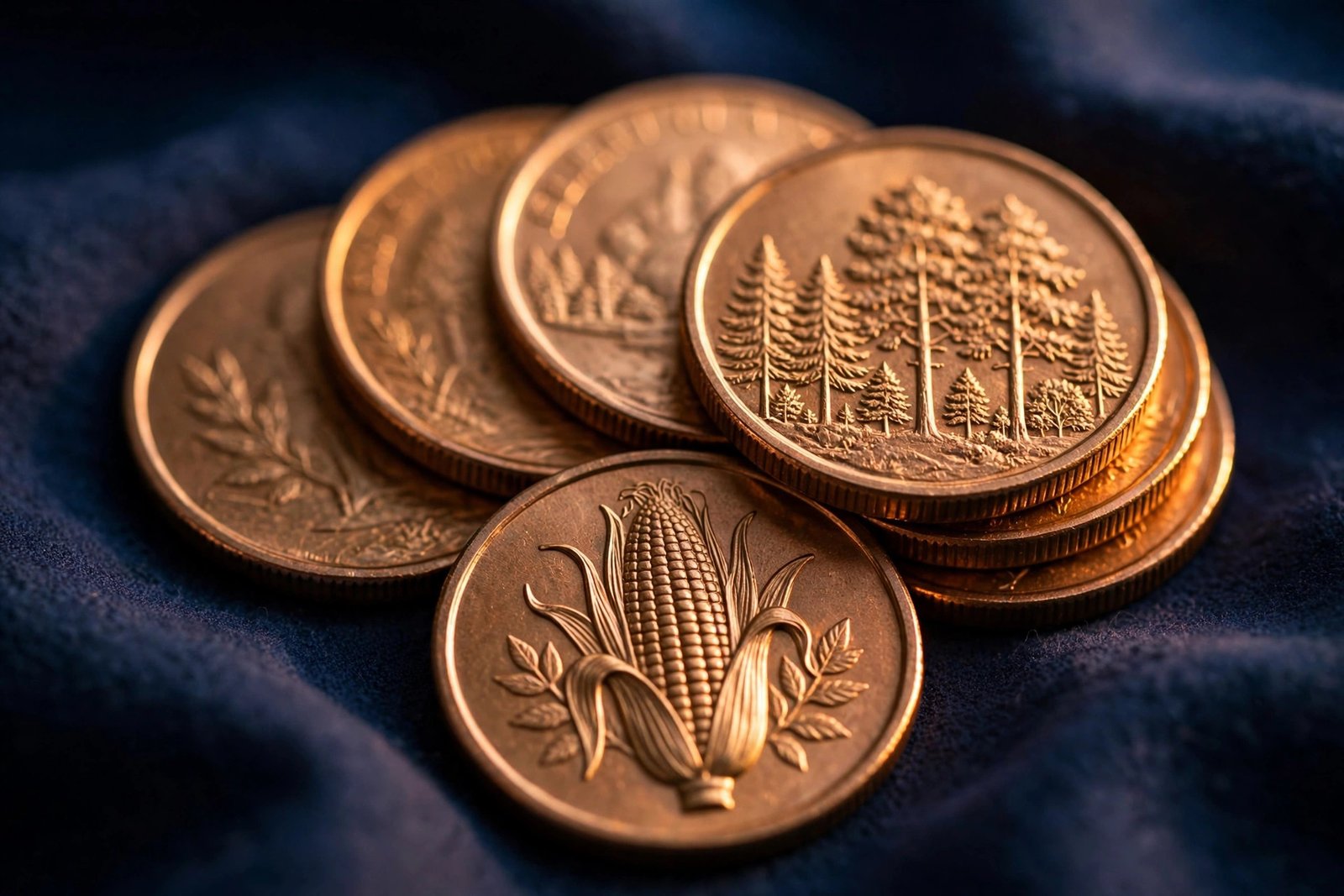
The Wisconsin reverse shows a cow, a wheel of cheese and an ear of corn. On some Denver-struck coins, an extra leaf appears on the corn stalk, to the lower left of the cheese wheel — either curving upward (Extra Leaf High) or drooping downward (Extra Leaf Low). It is raised from the coin’s surface, which is how you tell it from a scratch. No Philadelphia or San Francisco version exists; every confirmed Extra Leaf quarter is a 2004-D.
The cause is still debated and was never officially confirmed by the Mint — a die gouge or tooling damage is the usual explanation — so don’t repeat the sabotage story as established fact. What is established is the value. Circulated examples commonly trade in the tens to low hundreds of dollars, roughly $50–$150. In uncirculated grades, guide ranges run roughly $100–$300 for a High Leaf in MS-65 (NGC’s guide puts it at $270, against $160 for the Low Leaf), while the auction records stand at $2,530 for an Extra Leaf High and $6,000 for an Extra Leaf Low (PCGS MS-67, Heritage, January 2020).
Which variety is pricier by grade still disagrees by source — some guides put the High Leaf ahead, others the Low — so don’t take anyone’s word that one is always worth more than the other. And ignore the websites claiming $50,000, $400,000 or more: no such sale exists in any auction record. The real range is tens of dollars in circulation, hundreds in mint state, and a few thousand at the very top.
2005-P Minnesota Extra Tree — the doubled die with 50 lookalikes
The Minnesota reverse shows the state outline, a lake scene and a line of spruce trees. On a doubled die reverse from Philadelphia, a ghostlike extra spruce — or extra spruce boughs — appears to the right of the fourth full tree in the treeline. It is a doubled die, meaning the working die itself received a duplicated impression; it is not a die clash and not a scratch.
PCGS’s major variety is FS-801 (DDR-001), and it is the one commanding real money: roughly $40 in MS-65 and about $275 in MS-67, with more than 200 examples graded and the finest at MS-67. Circulated FS-801 examples are commonly put at about $30–$50. When the variety surfaced weeks after the quarter’s April 4, 2005 release, early examples sold for $500 or more — but that hype collapsed once more examples surfaced, so don’t use the $500–$700 figures still floating around round-up articles.
The catch is that over 50 doubled-die varieties are catalogued for the 2005 Minnesota quarter — some counts say 78 — and most are worth only a few dollars to about $50. A faint ghost tree on the wrong variety is not an FS-801. Attribution matters enormously here: if you think you have one, it needs PCGS or NGC attribution before any value claim, and the doubling must be rounded and raised, not flat and shelf-like.
2005-P Kansas “In God We Rust” — the grease error
On some 2005-P Kansas quarters, grease or debris clogged the “T” in “TRUST” on the reverse motto, so the struck coins read “IN GOD WE RUST” — the T weak or missing entirely. It is a struck-through-grease error, not a misspelling in the die design, and it is commonly valued at about $20–$100 or more depending on how completely the T is filled and on the grade. Don’t confuse it with the separate Kansas variety from the same year, the “humpback bison” die break — a raised lump on the bison’s back from a cracked die — which is a different error on a different part of the coin.
1999-P Delaware “Spitting Horse” — the modest classic
The very first state quarter carries the series’ first popular error. A die crack on the reverse runs a raised line from the horse’s mouth — Caesar Rodney on horseback — down through the “C” in “Caesar”, making it look as if the horse is spitting. Philadelphia only, and modest money: circulated examples commonly $3–$20, uncirculated $20–$40, with a bold crack in certified MS-65 or better occasionally reaching $50–$200. A faint line or heavy wear sits at the low end. Don’t confuse it with the separate 1999-P Delaware grease error, where the final “E” of “THE FIRST STATE” is missing and the coin reads “THE FIRST STAT”.
The silver proofs: the other way state quarters are worth more than 25 cents
Every state design was also struck in a 90% silver proof version at San Francisco, sold in collector sets and never released into circulation. The specs are the same as every 90% silver US coin of the era: 6.25 g (against 5.67 g for the clad version), 24.3 mm across, with 0.1808 troy ounces of pure silver inside. At the roughly $53-an-ounce silver price of November 11, 2026, that is about $9.60 of silver per coin — a floor, not a price, since proof sets trade above melt and the value moves with the silver market.
How to tell one from a clad proof: the S mint mark, a uniform silver edge with no copper stripe, and the weight — 6.25 g on a 0.01 g scale. All three together. San Francisco also struck clad proofs of the same designs, so an S on a shiny coin proves nothing by itself, and a gold-plated state quarter — the kind sold on TV — is a plated novelty with no collector premium at all.
If you want the broader silver-quarter picture, our guide to are your quarters silver covers the 1932–1964 Washington quarters, which are 90% silver in every mint mark, not just proofs.
Value table by grade
These are commonly cited guide and auction ranges, framed as estimates — guides disagree, especially on the Wisconsin varieties, and prices move with demand. The silver-proof row is a formula (0.1808 oz × the silver spot price), not a pinned figure.
| Coin | Circulated / worn | Uncirculated (MS-63–65) | Top grade (MS-66–67) |
|---|---|---|---|
| Ordinary state quarter, any design | 25 cents | About $1–$3 | About $5–$20 (a few 1999 designs higher) |
| 2004-D Wisconsin Extra Leaf High | About $50–$130 | About $100–$300 | Record $2,530 (MS-66, 2006) |
| 2004-D Wisconsin Extra Leaf Low | About $40–$100 | About $60–$200 | Record $6,000 (PCGS MS-67, 2020) |
| 2005-P Minnesota Extra Tree (FS-801) | About $30–$50 | About $40 (MS-65) | About $275 (MS-67) |
| 2005-P Kansas “In God We Rust” | About $20–$50 | About $50–$100+ | Depends on how complete the missing T is |
| 1999-P Delaware Spitting Horse | About $3–$20 | About $20–$40 | About $50–$200 (bold crack, certified) |
| 90% silver proof, any state (S mint) | n/a — proofs never circulated | About $10–$20 (near melt, set-dependent) | High-grade proof sets carry a premium over melt |
One more grade exception worth knowing: uncirculated state quarters in MS-67 and MS-68 can command large premiums for condition alone, even without an error — 1999 examples are cited at roughly $225–$725 in MS-67 and $4,500–$9,500 in MS-68 by design. But grading fees of $20–$50 mean it is not worth submitting ordinary MS-63–65 examples, and most coins pulled from circulation will never grade that high. If you are new to grading, read our guide on how to grade a coin before pricing anything.
Fakes, plating and cleaning warnings
State-quarter errors attract fakes because the premium is real and the diagnostics are subtle. Watch for these:
- Machine doubling passed off as a doubled die. Flat, shelf-like doubling is worthless; genuine doubled-die doubling is rounded and raised. This is the single most common misidentification in the Minnesota series, and it is also the trap in our 1955 doubled die penny guide — the same test applies.
- Plated coins. Gold-plated state quarters and silver-washed clad proofs are novelties, not rarities. The weight test (6.25 g for a real silver proof, 5.67 g for clad) catches them.
- Altered dates and added mint marks. Less common on state quarters than on key-date pennies, but any coin offered at a headline price with no certification deserves suspicion. For anything over about $100, PCGS or NGC certification is the protection — it authenticates the variety and locks in the grade.
- Cleaning. Never clean a find. Cleaning strips the original surface, and grading services designate cleaned coins as such — a cleaned Wisconsin Extra Leaf is worth a fraction of an untouched one. Our guide to never cleaning a coin explains what to do instead.
Two advanced notes, not change finds: all five 1999 designs exist struck on experimental golden manganese-alloy planchets tested for the Sacagawea dollar — a 1999-P Pennsylvania example graded MS-67 sold at Heritage in October 2006 for $10,200 — and a 2000 “mule” pairs a state-quarter obverse with a Sacagawea dollar reverse, with only 19 known. Neither is something you will find in a coin jar; they are Mint-test pieces and mint errors that escaped in tiny numbers, and they are mentioned here so you know the stories, not so you go hunting for them.
What to do if you find one
- Don’t spend it, and don’t clean it. Put it in a flip or a 2×2 holder, handle it by the edges, and keep it away from other coins.
- Photograph it. Clear, well-lit photos of both sides, plus a close-up of the error area, are what a dealer or grader will ask for first.
- Check the three things that matter. The right mint mark (D for Wisconsin, P for Minnesota), raised — not scratched — doubling or leaf, and the weight if you suspect silver.
- Get it attributed before you price it. For a Minnesota Extra Tree, that means confirming it is FS-801; for a Wisconsin Extra Leaf, confirming High or Low. PCGS and NGC both attribute both varieties.
- Decide whether grading is worth it. If the coin is a confirmed Extra Leaf in any condition, or a Minnesota FS-801 in uncirculated condition, certification usually pays for itself. A circulated Spitting Horse or a weak Kansas grease error is usually worth selling raw.
- Sell where the buyers are. A certified error sells best at auction or through a dealer who handles varieties; an ordinary circulated example sells best to a local dealer or a collector who knows the series. Our guide to how to sell your coins safely covers dealer vs auction vs online, and when to grade first.
FAQ
Are any state quarters worth more than 25 cents?
Yes, but only a few. The recognised errors — the 2004-D Wisconsin Extra Leaf, the 2005-P Minnesota Extra Tree (FS-801), the 2005-P Kansas In God We Rust and the 1999-P Delaware Spitting Horse — plus the 90% silver proof versions struck at San Francisco, and very high-grade uncirculated examples. An ordinary circulated state quarter is worth 25 cents.
How do I tell a Wisconsin Extra Leaf High from a Low?
Both are 2004-D quarters with an extra raised leaf on the corn on the reverse. On the High Leaf the extra leaf points upward, at about 45 degrees; on the Low Leaf it droops downward, roughly parallel to the ground. Neither is always worth more than the other — values depend on grade, and sources disagree on which variety is pricier.
Is my S-mint state quarter silver?
Not necessarily. San Francisco struck both 90% silver proofs and clad proofs of every state design. A silver proof weighs 6.25 g and shows a uniform silver edge with no copper stripe; a clad proof weighs 5.67 g and shows a copper stripe on the edge. Check the mint mark, the edge and the weight together.
Should I get my state quarter graded?
Only if the value justifies the roughly $20–$50 fee. A confirmed Wisconsin Extra Leaf in any condition, or a Minnesota FS-801 in uncirculated condition, is worth certifying. An ordinary circulated state quarter, a minor Minnesota doubled-die variety, or a common MS-63 example is not — the grading fee would eat the premium.
Values are estimates based on grade, authenticity and current market demand at the time of writing. A cleaned, damaged or counterfeit coin is worth far less. Get valuable coins certified by PCGS or NGC.